
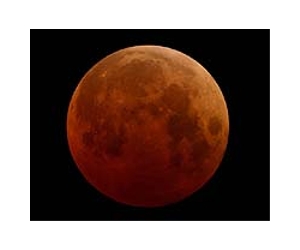
The December holiday sky show doesn't stop with the Geminid meteor shower – this year, the moon is also bringing a holiday gift. In the very early morning of December 21, or late night of December 20, depending on your time zone, a total lunar eclipse will make a dramatically colorful appearance – from bright orange to blood red to dark brown and perhaps gray.
The next total lunar eclipse will begin when the moon moves into Earth's penumbral shadow on December 21, 2010 at 5:29 UTC.
This last lunar eclipse of 2010 is especially well placed for observers throughout North America. The eclipse occurs as the moon passes through the northern portion of Earth's shadow, just four days before perigee, when the moon is closest to Earth.
Want to know more? Lunar experts from NASA's Marshall Space Flight Center will be hosting two live Web chats to discuss the eclipse. On Monday, Dec. 20 from 3-4 p.m. EST, Dr. Rob suggs will answer your questions. Later on Dec. 20, make plans to to stay "up all night" with astronomer Mitzi Adams at she answers your questions from midnight to 5:00 a.m. EST.
Joining the chat is easy. Simply return to this page a few minutes before each of the chats. The chat module will appear at the bottom of this page. After you log in, wait for the chat module to be activated, then ask your questions. See you in chat!
Live Video/Audio Feed
If you don't want to brave the December chill, or if your weather doesn't cooperate for lunar viewing, we have you covered! A live video feed of the lunar eclipse will be embedded on this page on Dec. 20. The camera is mounted at NASA's Marshall Space Flight Center in Huntsville, Ala.
More About the Chat Experts: Rob Suggs and Mitzi Adams
Dr. Rob Suggs is the Space Environments Team Lead in the Engineering Directorate of NASA's Marshall Space Flight Center. For the past 4 years he has managed the NASA Lunar Impact Monitoring Project which has recorded over 200 meteoroid impacts on the Moon using telescopes at 2 observatories. He has a Ph.D. in Astronomy from New Mexico State University (NMSU) and was part of the NMSU team which attempted to record the LCROSS spacecraft impact on the Moon last October.
In her 22-year career at the Marshall Space Flight Center, Mitzi Adams has conducted research for a variety of solar missions, including work with Marshall's vector magnetograph, a pioneering instrument that studied magnetic fields in sunspots; SOHO, a mission to study the sun from its deep core to the outer corona; and Hinode, a project to improve our understanding of the sun's magnetic field and the mechanisms that drive solar eruptions. As a guest lecturer for science courses at the University of Alabama in Huntsville, Adams works to sustain enthusiasm and engagement at the college level.
Janet Anderson,
Huntsville, Ala.
Share This Article With Planet Earth
