
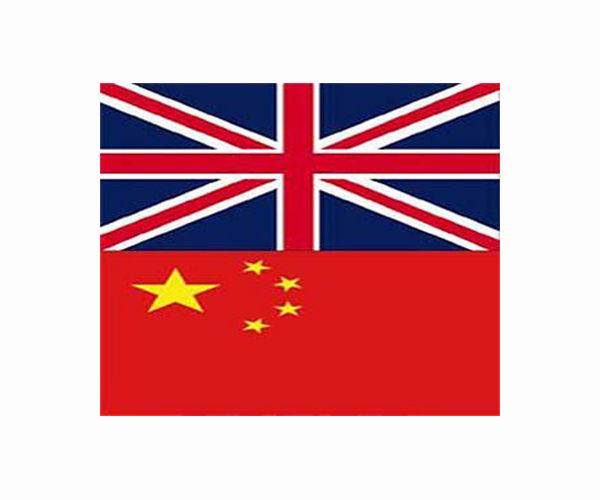
Britain announced Monday that a trade minister was heading to Taiwan for the first in-person talks since the coronavirus in a bid to strengthen ties with the island, a trip that sparked a rebuke from Beijing.
Trade Policy Minister Greg Hands will co-host annual talks and meet with Taiwanese President Tsai Ing-wen during his two-day visit, the Department for International Trade said.
The visit "is a clear signal of the UK's commitment to boosting UK-Taiwan trade ties. Like the UK, Taiwan is a champion of free and fair trade underpinned by a rules-based global trading system," the department said in its statement.
A spokesperson for Britain's de facto embassy in Taiwan told AFP that Hands' official programme would start on Tuesday.
Hands said boosting trade with a "vital partner" like Taiwan was "part of the UK's post-Brexit tilt towards the Indo-Pacific and closer collaboration will help us future-proof our economy in the decades to come".
Taiwan has seen a flurry of visits by foreign officials and lawmakers in recent months, the most high-profile of which was US House Speaker Nancy Pelosi, whose trip infuriated Beijing.
China claims the self-ruled island democracy as part of its territory to be seized one day, by force if necessary, and opposes any move that might lend Taiwan international legitimacy.
China staged unprecedented military drills in retaliation for Pelosi's visit in August, sending tensions to their highest level in decades.
Beijing's foreign ministry criticised the visit by Hands using rhetoric it often employs for such trips.
"China firmly rejects any form of official exchanges with the Taiwan region by any countries having diplomatic ties with China," spokesman Zhao Lijian said at a daily press conference.
Zhao said Beijing urged Britain to "stop any form of official exchanges with Taiwan and stop sending wrong signals to Taiwan separatist forces".
Like many countries, Britain diplomatically recognises Beijing over Taipei but it maintains unofficial relations with the island through a representative office.
The last time a British minister travelled to Taiwan was in 2018.
Britain said this week's talks would try to address barriers in some sectors including "fintech, food and drink and pharma" and that trade between the two had risen 14 percent the last two years to 8 billion pounds ($9 billion).
Taiwan to set up more language centres in US, Europe
Taipei (AFP) Nov 7, 2022 –
Taiwan on Monday unveiled plans to set up 25 more Mandarin learning centres abroad next year, expanding its soft diplomacy outreach as China's own cultural institutes face increased scrutiny over their operations.
Taipei currently operates 43 such centres overseas, including 23 established this year, as it seeks to bolster its cultural clout even as China steps up its economic, military and diplomatic pressure on the island.
Only 14 countries maintain formal relations with Taiwan instead of China, which claims the self-ruled democracy as part of its territory to be taken one day.
But many nations maintain unofficial ties with Taiwan and Western support has grown in recent years as China takes a more aggressive stance towards the island under President Xi Jinping.
Tung Chen-yuan, Taiwan's overseas affairs minister, said 25 new "Taiwan Centre for Mandarin Learning" facilities will be launched in Europe and the United States next year.
"We are providing more teaching materials on Taiwanese culture and I believe they (the students) will have a deeper understanding of Taiwan," he told a parliamentary session on Monday.
Establishing the centres in Europe and the United States is part of Taiwan's "national strategies" with a focus on teaching adults, he added.
China set up hundreds of Confucius Institutes — named after the ancient Chinese philosopher — in more than 150 countries in less than two decades, catering to a surge for knowledge about the world's most populous country and second largest economy.
Presented as China's answer to organisations such as Germany's Goethe-Institut or the British Council, they offer language lessons and cultural exchange programmes.
But as relations with Beijing have deteriorated and Xi has taken a more assertive foreign policy approach, an increasing number of critics in the West say the institutes have become a threat.
Dozens of Confucius Institutes have closed down in the United States, Canada, Australia and some European countries in recent years under growing scrutiny.
In June, Germany's Education Minister Bettina Stark-Watzinger warned the language centres were being "used by the Communist Party for political ends".
The German interior ministry said any cooperation between German universities and Confucius Institutes was "extremely critical security-wise" and risked "insidiously restricting academic freedom".
Britain's new Prime Minister Rishi Sunak has previously vowed to close all 30 Confucius Institutes in Britain.
