
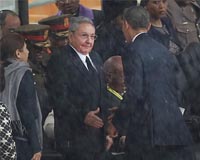
Relations between the United States and Cuba, more strained than neighborly over the past century, have seen US occupations, Cold War enmity, and even the brink of nuclear war.
Here are some key events in US-Cuba relations, as the two sides prepare for historic talks on Wednesday and Thursday aimed at normalizing diplomatic relations:
– 1898-1902: After the Spanish-American War, the United States occupies former Spanish colony Cuba, pulling out only after Cuba agrees to terms making the island independent in name only.
– 1906: The United States occupies Cuba again, staying three years.
– January 1, 1959: Fidel Castro leads the ouster of US-backed dictator Fulgencio Batista.
– 1961: After the United States breaks diplomatic relations with Cuba, the Central Intelligence Agency organizes the doomed Bay of Pigs invasion by Cuban exiles.
– 1962: The 1960 US embargo is expanded to cut off all trade with Cuba except food and medicine. Soviet missiles are then discovered in the country, sparking the 13-day nuclear crisis.
– 1965: Cuba allows hundreds of exiles to sail to the United States in the October-November Camarioca boatlift. US President Lyndon Johnson establishes "freedom flights," and 260,561 Cubans leave until the program ends in April 1973.
– 1977: US-Cuban relations improve slightly with the establishment of "Interests Sections" in each other's capitals.
– 1980: The Mariel boatlift: Castro says anyone wanting to leave can do so through the port of Mariel. Some 125,000 refugees arrive in Florida by late September.
– 1996: The US Congress passes the Helms-Burton Act strengthening the embargo against Cuba.
– 1999-2000: Elian Gonzalez, a Cuban boy who survived a shipwreck while fleeing Cuba, becomes the focus of a six-month politically charged international custody battle. US eventually forcibly repatriates him. US President George W. Bush tightens the embargo, making it harder to travel or remit money to Cuba.
– May 2002: Former US president Jimmy Carter visits Cuba, becoming the first US leader in or out of office to do so since Castro took power.
– November 2004: Havana bars US dollars for commercial transactions, making the Cuban peso the only currency allowed in business transactions.
– December 2009: Alan Gross, a government contractor for the US Agency for International Development, is arrested for importing banned computer technology for distribution to Cuba's small Jewish community.
– March 2011: Gross is sentenced to 15 years in prison for "acts against the independence or territorial integrity of the Cuban state."
– Spring 2013: Obama authorizes exploratory negotiations with Cuba on normalizing ties, leading to secret negotiations.
– Early summer 2014: Pope Francis makes personal appeals in letters to presidents Obama and Castro, adding impetus to the talks. The Vatican hosts US and Cuban delegations in the fall.
– December 17, 2014: US President Barack Obama and Cuban leader Raul Castro simultaneously announce plans to normalize ties and the release of prisoners. Cuba releases Gross, now 65, and a Cuban spy, while the United States frees three Cubans imprisoned on espionage charges.
– January 12, 2015: US announces that Cuba has released 53 political prisoners as part of the normalization deal.
– January 15, 2015: The US government eases travel and trade restrictions, allowing certain approved categories of Americans like journalists, scholars, artists and athletes to visit Cuba without asking for a special license. The embargo, however, remains in place until Congress votes on it.
– January 21-22: The highest-level US delegation in 35 years is due in Havana for talks on migration and negotiating the reopening of embassies.
