
A lucky nine graduate students, ranging from industry participants to foreign nationals, spent the evening presenting their concepts and projects for some of the parts needed to land objects and colonize with man the moon above. I say lucky in that the audience contained some great space minds who were wry with commentary. The Space Concepts Studio: Space Exploration Architectures event was time well spent by all participants and I think left many thinking of tangential ideas to dream big with enthusiasm for space architecture.
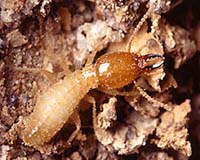
In speaking with the publisher of spacedaily.com about this event I was struck by the comment about recycling of ideas and the rare find of a gem. I think I made the case that USC is producing new thoughts and direction for the application of in-situ resources on the moon and in some cases for getting there. The crowd pleaser of the evening was the building of termite farms on the moon to generate hydrogen.
"Social animals working toward the survival of the whole," spoke Graduate student Gokee Ince.
Ms. Ince's idea was for Termite Colonies to be grown on the moon and in-situ feedstock from an assumed existing green house. The hydrogen production was also seen to be routed to a fuel-cell that generated power and the by-product water was used to keep the termite colony moist.
Ms. Ince delighted the audience with answers to a question by ISU Board Member Michael Potter about her inspiration. She said something like "I had a termite problem and then had this assignment and the two just clicked." Pure inspiration was a pleasure to see.
The other presentations deserve no less praise as the Termite Hydrogen Colonies. Beginning with the opener by Peter Xaypraseuth which presented Inflatable Lunar Towers for increasing exploration range by line-of-site towers spread over long distances. Peter's project focused on the advantage of the towers for preventing contamination and thus loss-of-efficiency from Lunar Dust. Most of the presentations featured comments about Lunar Dust (as though that was a requirement.)
Peter also stressed the valuable scientific research increase from having cameras as such a low altitude. The audience seemed to focus on satellites in orbit as a cheaper solution as Peter's towers were awfully heavy. Peter stuck to the value of line-of-site scientific capabilities and seemed content with the knowledge that his idea can work.
Colonel and former test pilot Bill Haynes helped the next presentation in talking about Lunar Dust Hay fever and how new spacesuits are focused on getting rid of "Pre-Breathing" altogether.
The Lunar Dust Mitigation Airlock was designed based on Japanese home design by Jen Treese. Besides her magnetic presentation, she proposed the use of electro-magnets for clearing lunar dust from moon explorers before they enter their habitat.
One of the habitat ideas presented was the use of Lunar Lava Tubes to create underground living structures that had many benefits and potential. This idea was presented by Richa Jolly who works for the Aerospace Corporation as a design engineer for spacecraft.
"Constant temperatures are easier to control than rapid and intense changes on the surface," was a key point delivered by Ms. Jolly.
"Radiation exposure is a key risk factor, commented Dr. Marc Cohen, Space Architect at Northrop Grumman, this goes to missions lasting more than a year."
A series of presentations talked about lunar power production with the logical conclusion that nuclear power is the most viable solution. This is primarily due to lunar dust and the lunar night. Graduate student Chien-Hui Lin focused on solar thermal sterling engines and did a good job talking about the power needs of various moon activities such as mining. James Moore gave the compelling argument for nuclear with a good focus on nuclear already works, its compact and is great for the lunar night.
One brave student praised lunar dust as a ready in-situ resource for oxygen and building materials. Chris Swan made a persuasive argument for lunar dust scoopers and the processing of the material with high-heat to break down the material, extract oxygen and cool the slag into bricks.
"Every gram you bring to the moon is very costly. There is a tremendous drive to use in-situ materials," Col. Hayes said in giving his approval for Mr. Swan's presentation.
Finally almost away from the lunar dust Amy Hallock spoke about space-based wireless power transmission and its applications in colonizing the moon and meeting power needs on earth. Her presentation seemed most realistic in using wireless power transmission to power a dozen LEO satellites. In total one power station and 12 wireless powered satellites would be much cheaper to launch. She also did touch on the fact that space-based wireless power would be immune to lunar dust.
Funding seemed to be a big question for space-based power from the audience with Ms. Hillock answering that early funding will be primarily from the military for the application of sending power to the front. Because energy is such an expensive commodity on earth, space-based solar power might be the domain of capitalism instead of governments.
No moon discussion today can forget the Google Lunar X-Prize and the audience was engaged with Mr. David Combs as he pitched his plan for how he would with the prize. David works on GPS Satellites for Boeing. The first $7 million would be spent on a rocket ride on SpaceX's Falcon -1. He grinned that Elon Musk is offering a 10% discount to Google competitors and was able to keep a fun and realistic tone throughout his presentation.
This explorers evening was put together by Madhu Thangavelu, professor of Astronautics and Architecture at USC. Congratulations Madhu and all of the presenters for an excellent evening of space adventure.
