
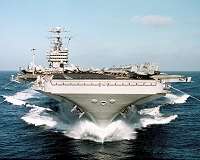
The Nimitz-class aircraft carrier USS John C. Stennis and surface combatants from it's carrier strike group docked at Changi Naval Base in Singapore Nov. 24th for a scheduled port visit.
The Ticonderoga-class cruiser USS Mobile Bay and the Arleigh Burke-class destroyer USS Spruance will be docked as well, according to the U.S. Navy.
The visit to "the Lion City" by assets of the John C. Stennis CSG lets the crew enjoy the bustling port city dynamic ports in the world and build relations, the Navy said in a press release.
"Every Sailor in Carrier Strike Group 3 is excited and grateful for the opportunity to visit Singapore," said Rear Adm. Mike Wettlaufer, commander of the carrier strike group.
"In addition to this opportunity to enhance our partnership with the Republic of Singapore Navy, the diverse food options, recreational and entertainment activities, and chance to experience local cultures make this an ideal place for our team to enjoy some well-deserved rest," Wettlaufer said.
CSG 3 had recently completed a dual-carrier exercise with the USS Ronald Reagan strike group. Other components to CSG 3 include Carrier Air Wing 9 and Destroyer Squadron 21, headquarters onboard the Stennis.
The USS John C. Stennis is a Nimitz-class nuclear powered aircraft carrier with a wing of 70 or more planes, helicopters and unmanned aerial vehicles. Its strike group is composed of destroyers, cruisers, support ships and typically one or two submarines, though the Navy rarely publicizes the locations of its submarines.
US bombers no longer flying over Korean peninsula: US general
Washington (AFP) Nov 26, 2018 – US bombers are no longer conducting flights over South Korea after Seoul asked for such missions to be paused, a US general said Monday.
General Charles Brown, who heads US Pacific Air Forces, told Pentagon reporters that the break was to help create space for ongoing diplomatic efforts to address North Korea's nuclear activities.
"As we're going through the diplomatic aspect, we don't want to actually do something that's going to derail the diplomatic negotiations," Brown said.
"So that's part of the reason why we're not doing (flights) over Korea."
As part of its so-called "Continuous Bomber Presence Mission," the US Air Force has kept B-1Bs, B-52s and B-2s on the US territory of Guam since 2004.
It routinely conducts flights over the region, often with partners including Japan, South Korea and Australia, as a way of training and exerting a strong military presence against North Korea and other potential adversaries.
Brown said despite not flying over the Korean peninsula, the overall number of bomber flights has not changed.
The US and South Korea have scaled back or scrapped several joint military drills since a historic summit between North Korean leader Kim Jong Un and President Donald Trump in Singapore in June.
At the meeting, Trump announced the US would stop holding joint exercises with the South, calling them expensive and "very provocative."
US Defense Secretary Jim Mattis last week said the US and South Korea are reducing the scope of "Foal Eagle," a joint drill scheduled for spring 2019.
Foal Eagle is the biggest of the regular joint exercises held by the allies, and has always infuriated Pyongyang, which condemned it as preparations for invasion.
