
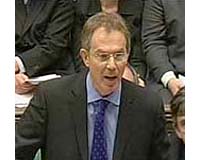
US Defense Secretary Robert Gates arrived here Sunday for talks with British Prime Minister Tony Blair on whether more troops are needed in Afghanistan to deal with a resurgent Taliban. The new US defense chief also planned to quiz Blair and British Defence Secretary Des Browne on the situation in southern Iraq and Britain's plans to reduce its forces there, a senior US defense official said.
Britain has about 5,600 troops in Afghanistan as part of the NATO-led reconstruction and security force and around 7,000 in Iraq, centred on Basra.
"I'm looking forward to meeting with the prime minister and my counterpart in defence to talk about both Afghanistan and the situation in Iraq," Gates told reporters on the flight to London from Washington.
"The first priority is to make sure we preserve the gains we've achieved in Afghanistan and to talk about the way forward in Iraq," he said.
Gates, whose itinerary was kept off the record for security reasons, is to travel to Afghanistan in the coming days to assess the situation with US and NATO commanders and look for ways to strengthen the Karzai government.
The US defense official, who briefed reporters traveling with Gates on condition of anonymity, said intelligence indicates that the Taliban will try to build on their offensive of last year, the biggest and bloodiest since they were ousted from power in 2001.
"We have information they are planning a spring offensive. We want to make sure we are prepared to take that on… and perhaps deal them a further setback."
Even though the Taliban suffered losses last year, the official said, "there was a higher level of activity and a higher level violence and they want to try to build on that, and you want to make sure they don't."
He said the British may be considering sending more troops to Afghanistan and Gates wanted to talk to them about that.
The US defense chief also wants to find out from commanders on the ground in Afghanistan "whether they have the resources they need," the official said.
The United States has about 22,000 troops in Afghanistan, about half of them with the NATO-led International Security Assistance Force which is taking over responsibility for security throughout the country.
There are more than 33,000 ISAF soldiers in Afghanistan, about a third of them in the south, which is the heartland of the Islamist Taliban movement and sees most insurgency-linked violence.
A former CIA director, Gates was last involved in Afghanistan as the spy agency's number two when it armed and funded an Islamic insurgency that drove Soviet forces from the country in the 1980s.
While in London, Gates is also expected to explain aspects of President George W. Bush's new Iraq strategy, including its heightened emphasis on Iran and Syria, the official said.
He indicated that Gates would not be asking British troops to play a role in the new security plan, which is centered on Baghdad, adding that US commanders felt they had all the coalition troops they needed.
Gates wants to know more about Britain's assessment of the situation in the south and get answers to questions about their plans for their troops there, the official said.
He said Gates planned to travel to southern Iraq to get the views of commanders there.
Although relatively quiet, the region is a particular concern because of its long, open border with Iran and Tehran's influence with Shiite groups that are competing for power in the south.
The United States has accused Iran's Islamic regime of smuggling arms, advanced explosive devices and fighters to Iraq to attack US forces and destabilize.
Last week, US forces arrested five Iranians it said were involved in activities directed against US forces in a controversial raid in the northern Kurdish city of Arbil.
Gates' trip comes less than one week after Bush announced he is sending more than 20,000 additional US troops to Iraq to try to break a spiral of sectarian violence in the Baghdad area.
Gates testified for two days in defense of the plan, but acknowledged that success will hinge on the Iraqi government delivering on a series of military and political commitments made by Prime Minister Nuri Al-Maliki.
Maliki had wanted the crackdown in Baghdad to be carried out by Iraqi forces, but "grudgingly" accepted the need for US troops, Gates told members of the Senate Armed Services Committee last week.
earlier related report
Germany mulls sending aircraft to Afghanistan
Brussels (AFP) Jan 12 – Germany plans to send six Tornado jets to southern Afghanistan, probably for reconnaissance duties in the insurgency-hit region, a former German defence minister said Friday.
"The German foreign minister will present the offer for six Tornados on January 26 at a meeting of NATO foreign ministers" in Brussels, said ex-minister Peter Struck.
A final decision on the move is unlikely before the end of the month, as it remains unclear whether the German parliament would have to endorse a new mandate for the planes.
Struck, on a visit to Brussels, told reporters that it might be possible to send the fighter-bombers for two or three months but that a deployment of seven months, for example, "would surely not be covered by the current mandate."
A German government spokesman said only that "no decision has been taken".
NATO officials acknowledged that they were aware of a possible offer from Germany, and Secretary General Jaap de Hoop Scheffer said he would welcome such a move.
"If the German government would announce, or has announced, the deployment of Tornado aircraft in a reconnaissance role to Afghanistan, I would highly welcome such a decision," he told reporters.
The move, should it go ahead, could ease criticism that Germany has ignored calls to help provide reinforcements to fight Taliban-led insurgents in the south and preferred to keep its troops in the relatively calm north.
NATO leaders agreed in November to move troops around inside Afghanistan in emergency cases, as commanders demand more flexibility to fight the insurgents.
The insurgency claimed the lives of around 3,700 people last year — four times more than in 2005, according to official figures. Around 120 foreign soldiers were killed.
Source: Agence France-Presse
