
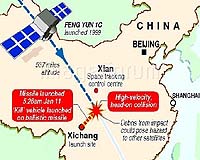
US Defense Secretary Robert Gates said Tuesday he was very troubled by a recent Chinese anti-satellite weapons test because of what it says about Beijing's strategic outlook. China on January 11 shot down one of its own orbiting weather satellites in space with a ballistic missile, acknowledging the test nearly two weeks later only after it provoked an international outcry. "I think that the Chinese ASAT test is very troubling," Gates told a Senate Armed Services Committee hearing.
"And perhaps what is as troubling as the technical achievement is how one interprets it as a part of … their own strategic outlook, and how they would anticipate using that kind of a capability in the event of a conflict, and the consequences for us of that," he said.
General Peter Pace, the chairman of the Joint Chiefs of Staff, told senators he did not believe China intended to use such an anti-satellite weapon anytime soon.
"On the other hand, it is a unique capacity in the world. And we need to, in a very separate conversation, take a look at where are we with regard to that capacity, where should we be, and if there is a gap, how we close it," he said.
earlier related report
Russia Against Militarizing Outer Space
Moscow, Russia (RIA Novosti) Feb 07 – Russia's defense minister said again Tuesday that the country is vehemently opposed to the militarization of outer space. Sergei Ivanov, who is also a deputy prime minister, reiterated Moscow's wholly negative reaction to a successful missile test launch carried out by Beijing last month, which destroyed an aging Chinese weather satellite.
Earlier, Ivanov said China was not the first nation to have used missiles to shoot down targets in outer space.
"It is not China that opened up Pandora's box," he said.
He admitted that the United States and Russia have also used outer space for military purposes, but said a clear distinction should be made between doing so for self-defense and to intimidate other nations.
"The use of outer space for security and defense purposes is one thing, and the placement of weapons there is quite another," he said. "The latter is absolutely unacceptable in our view, as it makes the global security situation unpredictable."
China's January 11 ballistic missile launch, revealed only two weeks later, caused an international uproar and raised concerns about the emerging world power's military ambitions.
The Chinese leadership, however, has denied seeking an arms race in space.
