
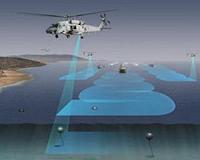
Northrop Grumman's AN/AES-1 Airborne Laser Mine Detection System has achieved initial operational capability with the U.S. Navy.
The Airborne Laser Mine Detection System, or ALMDS, is a sensor pod manufactured by Northrop Grumman to improve mine detection capabilities for naval platforms. Company officials say the delivery of the system will make Navy personnel safer during deployment.
"With Initial Operational Capability, the ALMDS program has delivered a new and important capability to the Navy and to our nation — the first of its kind for mine warfare," assistant program manager Erik Maskelony said in a press release.
The ALMDS is a sensor pod designed to integrate with naval-deployed rotary-wing aircraft. The pod uses laser technology to scan and detect naval mines.
"Using forward motion of the aircraft, ALMDS' pulsed laser light generates 3-D images of the near-surface volume to detect, classify and localize near-surface moored sea mines," Northrop Grumman directed energy vice president Mark Skinner added. "Highly accurate in day or night operations, the untethered ALMDS sensor conducts rapid wide-area searches with high accuracy."
The product has been demonstrated on a UH-60M Black Hawk helicopter in addition to an MH-60 Seahawk, but can be installed on other aircraft types.
Italy joins EUROSAM's Aster 30 B1NT program
Rome (UPI) Jan 13, 2017 –
EUROSAM, a consortium formed by Thales Group and MBDA Systems, has formally welcomed Italy to its Aster 30 Block 1 NT program.
The B1NT program is an effort supported by the French and Italian defense ministries to develop new technology for the Aster missile in addition to modernizing SAMP/T systems currently in service.
"The Italian notification strengthens the Aster program well beyond the financial and technological contribution," MBDA CEO Antoine Bouvier said in a press release. "Once again, cooperation in Europe adds up to far more than the sum of its parts."
Aster missiles are currently used by European operators to defend against ballistic missile threats. The B1NT program aims to expand the capability against additional threats.
"After the current Aster 30 Block 1, which gave Europe its first defence capability against theatre ballistic missiles, the Aster 30 Block 1 NT will allow to extend this capability to more complex threats and will also deal with the emerging threat of Anti-Ship Ballistic Missiles," Bouvier added.
