
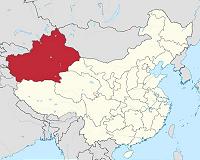
The US Senate has approved a bill to press China on its treatment of Uighurs, requiring the US government to closely monitor the mass incarceration of the community and consider punishment of those responsible.
The Senate unanimously approved the so-called Uighur Human Rights Policy Act late Wednesday. It still needs passage by the House of Representatives, which is highly likely as the bill enjoys wide bipartisan support.
The act would require US intelligence to produce a report within six months on the crackdown in Xinjiang, the western region where as many as one million Uighurs and other mostly Muslim minorities are being held in re-education camps.
It would also establish a State Department special coordinator on Xinjiang and ask the FBI to assess reports of harassment by China of US citizens and residents of Uighur heritage.
The bill also asks Secretary of State Mike Pompeo to consider sanctions on Chinese officials behind the policy, notably Chen Quanguo, the Communist Party chief for Xinjiang.
"It's long overdue for the United States to hold the Chinese government and Communist Party officials accountable for the systemic and egregious human rights abuses and probable crimes against humanity in Xinjiang," said Marco Rubio, the senator who introduced the bill and a Republican ally of President Donald Trump.
The Uighur Human Rights Project, a Washington-based pressure group, hailed the bill as a key step in building international pressure.
"This is the first legislation passed by any nation responding to the Uighur human rights crisis, and sends a powerful message to Beijing," it said in a statement.
The Trump administration has repeatedly criticized China, with Secretary of State Mike Pompeo recently calling Beijing's treatment of Uighurs one of the "worst stains on the world."
But some activists say that US actions have gone little beyond statements at a time when Trump is embroiled in multiple feuds with China, most notably on trade.
Senator Bob Menendez, a Democrat who introduced the bill with Rubio, said the measure showed that the United States was not turning a blind eye even though the Trump administration "has not seen fit to make the tragic situation in Xinjiang a priority."
Rights groups and witnesses accuse China of forcibly trying to draw Uighurs away from their Islamic customs and integrate them into the majority Han culture.
After initially denying their existence, Beijing now defends the camps, which it calls "vocational education centers," as a necessary measure to counter religious extremism and terrorism.
Uzbekistan to waive visa restrictions for Chinese citizens
Tashkent (AFP) Sept 12, 2019 –
Uzbekistan said Thursday that it will lift visa restrictions for citizens from China in a bid to boost foreign tourism, becoming the first country in former Soviet nation in Central Asia to make the move.
An order signed by President Shavkat Mirziyoyev said that Chinese citizens including those from Hong Kong would be subject to a seven-day visa waiver from the beginning of 2020.
Uzbekistan, which does not share a border with China, is the first of the five 'stans' in ex-communist Central Asia to scrap visas for Chinese citizens.
While China is a key trade partner for the region Beijing has often struggled to counter perceptions that it is out to dominate its weaker neighbours via loans and strategic investments.
Uzbekistan has made tourism a priority to reduce its dependence on exports of its natural resources, including natural gas and metals.
The country's star draws are the fabled cities of Bukhara, Samarkand, Khiva, which were once cultural centres and key points along the historic Silk Road trade routes linking China and Europe.
Uzbekistan's tourism committee has said that annual visitor numbers for 2018 were 5.3 million, double the figure for 2017.
President Mirziyoyev has reversed a number of policies that hampered tourism under his late predecessor Islam Karimov.
Among the restrictions he scrapped was a ban on photography in the capital Tashkent's ornate metro system that had led to police detentions of unsuspecting tourists.
