
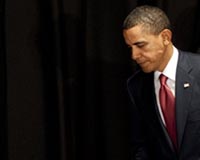
President Barack Obama on Tuesday expressed grave concern over the plight of the Syrian town of Kobane under attack by Islamic State jihadists, and said a US-led coalition would keep up bombing raids there and in western Iraq.
"We're deeply concerned about the situation in and around the Syrian town of Kobane," Obama said after meeting commanders from a coalition of more than 20 countries fighting the IS group.
The US president, sitting next to his national security adviser Susan Rice and the US military's top officer, General Martin Dempsey, said the US government was "also focused on the fighting that is taking place in Iraq's Anbar province."
The battles in Anbar province and Kobane illustrated the threat posed by the IS group in both Iraq and Syria and "coalition air strikes will continue in both these areas," he said.
Obama said there had been some "important successes" in the campaign against IS militants, citing the successful bid to retake and hold Mosul dam in Iraq.
The coalition chiefs agreed that "this is going to be a long term campaign," he said.
"There are going to be periods of progress and setbacks," he said.
But Obama added: "We are united in our goal."
The effort to defeat IS was not merely a military operation and the campaign would require tackling the group's extremist ideology and its funding sources, Obama said.
The coalition would need to communicate an "alternative vision to those attracted" to the IS group, he said.
White House insists 'succeeding' against IS
Washington (AFP) Oct 14, 2014 –
The US strategy to defeat Islamic State jihadists in Iraq and Syria is "succeeding," the White House said Tuesday, as President Barack Obama prepared to meet with allied defense chiefs.
"We're in the early days of the execution of that strategy. But certainly the early evidence indicates that this strategy is succeeding," White House spokesman Josh Earnest said.
"There are specific episodes where the use of military force has succeeded in beating back an ISIL advance or stopping the siege of a vulnerable humanitarian target," he said, using another IS acronym.
Earlier, US Central Command said US-led aircraft hammered Islamic State jihadists with 21 bombing raids near Kobane on Monday and Tuesday, amid signs the strikes had "slowed" the group's advance on the Syrian border town.
Earnest called this a "continuation of our broader strategy, not a change in it," when asked if the stepped-up strikes represented a shift.
Despite the allied firepower, IS militants recently captured nearly half of Kobane and seized most of Iraq's largest province, Anbar, to add to their self-proclaimed Islamic "caliphate".
Earnest acknowledged that the fight would not be quick or easy.
"We've been pretty candid about the fact that this is a longer-term proposition," he told reporters.
He also again insisted that US ground troops would not be involved in the battle against the Islamic State group, which has seized large swathes of territory in both Iraq and Syria.
Earnest instead explained that a core component of the coalition strategy was to "build up the capacity of Iraq security forces and we can build up the capacity of Syrian opposition fighters to take the fight to ISIL."
"That is a necessary component of the strategy that will allow us to see more significant results on the battlefield," he said.
