
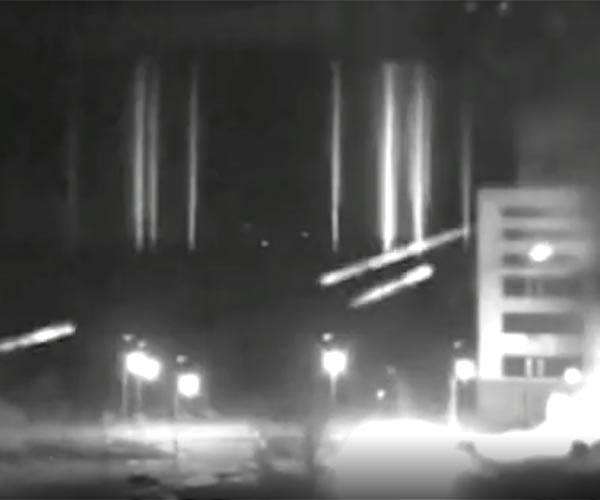
The Russian shelling of Zaporizhzhia nuclear power plant in Ukraine — the largest in Europe — has sparked international outrage and fears over the country's 15 operational reactors.
The Zaporizhzhia reactors, apparently undamaged by the attack, were taken over by invading Russian forces that have also stationed themselves at Chernobyl, the site of the worst civilian nuclear disaster in history.
Experts have condemned the attack, while stressing that Ukraine's modern reactors are built to withstand most human-caused and natural impacts.
Here's what we know about nuclear power in Ukraine:
– Nuclear-powered nation –
Ukraine is the seventh-largest producer of nuclear electricity in the world, according to International Atomic Energy Agency (IAEA) figures for 2020.
The country, which relies on nuclear energy for more than half of its power supply, has made significant improvements in nuclear safety over the years, experts say.
Zaporizhzhia has six of the country's 15 reactors and can create enough energy for four million homes.
The plant is "relatively modern", said Mark Wenman of Imperial College London, noting its reactor components are housed inside a heavily reinforced containment building that can "withstand extreme external events, both natural and man-made, such as an aircraft crash or explosions".
"The design is a lot different to the Chernobyl reactor, which did not have a containment building, and hence there is no real risk, in my opinion, at the plant now [that] the reactors have been safely shut down," he told the Science Media Centre.
The battle at the site caused a fire at an adjacent training facility, IAEA chief Rafael Grossi said early Friday.
He said only one of the six reactors was operating at about 60 percent, another had been undergoing maintenance, two were in "safety-controlled shutdown" and the last two "were already being held in reserve and are operating in low-power mode".
Ukrainian monitors say there has been no spike in radiation.
– Conflict fears –
Earlier this week Greenpeace warned that the Russian invasion risks a "nightmare scenario" at one of the country's nuclear sites, potentially involving an explosion that caused cooling systems to fail and large amounts of radioactivity to be spread on the wind.
This, the charity said in an analysis focusing on Zaporizhzhia, could render large parts of Europe and Russia "uninhabitable for at least many decades".
The main risk now is a loss of the power supply as the plant needs water and electricity to operate the safety systems and cool the reactor core, according to Karine Herviou, Deputy Director General of the French Institute for Radiation Protection and Nuclear Safety.
But the site has emergency generators, which normally have fuel to operate for seven to 10 days, as well as water reserves.
The other risk is direct aggression.
Herviou said the containment buildings offer protection to a point "but it all depends on what we are talking about".
An attack that hit another part of the plant could affect safety systems, she added.
– Chernobyl –
Ukraine, which has significant uranium reserves, began developing nuclear power in the 1970s — when it was still a part of the USSR — with the construction of Chernobyl.
The 1986 Chernobyl disaster left hundreds dead and spread radioactive contamination west across Europe.
Damaged Reactor No. 4 was initially covered by a temporary sarcophagus, then by a containment arch completed in 2017.
Russia seized the site on February 24.
The Ukrainian authorities have recently noted an increase in radiation at Chernobyl, but the IAEA has said the levels measured pose no danger to the public.
Experts have speculated that military activity around the site may have kicked up contaminated dust.
Ukraine's current stock of reactors are Soviet or Russian-designed VVERs, which are pressurised water reactors.
"Ukraine receives most of its nuclear services and nuclear fuel from Russia," says the World Nuclear Association, although it has noted that the country had already begun "reducing this dependence".
The nuclear operator Energoatom has recently turned to the US firm Westinghouse to build new reactors.
US calls attack on Ukraine nuclear plant a possible 'war crime'
Washington (AFP) March 4, 2022 – The United States on Friday called an attack attributed to Russian forces against a nuclear power plant in Ukraine a possible war crime.
"It is a war crime to attack a nuclear power plant," tweeted the US embassy in Ukraine — which was moved out of the capital Kyiv because of the Russian invasion — after the overnight attack at the nuclear plant in Zaporizhzhia.
Asked by AFP whether Washington was openly accusing Moscow of having perpetrated a war crime prohibited by the Geneva Convention, the US State Department was more cautious.
"The intentional targeting of civilians or civilian objects, including nuclear power plants, is a war crime, and we are assessing the circumstances of this operation," a State Department spokesman said.
"But regardless of the legality, this action was the height of irresponsibility, and the Kremlin must cease operations around nuclear infrastructure," the official said.
Russian defense ministry spokesman Igor Konashenkov claimed the attack on Zaporizhzhia was staged by "Ukrainian sabotage groups, with the participation of foreign mercenaries".
Washington has in recent days accused Russia of hitting civilian infrastructure and killing civilians in Ukraine, but has been careful not to explicitly say that the Russian military was intentionally targeting them, or to openly discuss war crimes.
White House spokeswoman Jen Psaki said during a briefing that there was "an internal review" underway to "collect evidence and data of targeting of civilians of the recorded use of horrific weapons of war on the ground in Ukraine."
"That's an ongoing process. We have not made a conclusion. It's a legal review and a process that goes through the administration," she said.
British Prime Minister Boris Johnson on Wednesday called Russian President Vladimir Putin a war criminal.
"What we have seen already from Vladimir Putin's regime, in the use of the munitions that they have already been dropping on innocent civilians, in my view already fully qualifies as a war crime," Johnson said.
US condemns 'reckless' Russian attack on Ukrainian nuclear plant
United Nations, United States (AFP) March 4, 2022 –
Russia's "reckless" overnight attack on a nuclear power plant in Ukraine is a dangerous escalation that "represents a dire threat to all of Europe and the world," the US ambassador to the United Nations said on Friday.
"By the grace of God, the world narrowly averted a nuclear catastrophe last night," Linda Thomas-Greenfield told the Security Council.
"Russia's attack last night put Europe's largest nuclear power plant at grave risk," Thomas-Greenfield said.
"It was incredibly reckless and dangerous. And it threatened the safety of civilians across Russia, Ukraine and Europe," she said.
"Nuclear facilities cannot become part of this conflict," Thomas-Greenfield said.
She urged Russian leader Vladimir Putin to end the invasion of Ukraine.
"Not only has he not listened, we've just witnessed a dangerous new escalation that represents a dire threat to all of Europe and the world," Thomas-Greenfield said.
"President Putin must stop this humanitarian catastrophe by ending this war and ceasing these unconscionable attacks against the people of Ukraine," she said. "Mr. Putin must stop this madness, and stop it now."
Moscow's ambassador to the United Nations denied accusations that Russian forces had shelled Europe's largest atomic power plant in Zaporizhzhia.
"These statements are simply untrue," Vassily Nebenzia told the Security Council. "This is all part of an unprecedented campaign of lies and disinformation against Russia."
He said Russian troops had exchanged small arms fire with Ukrainian forces at Zaporizhzhia but had not shelled the facility in southern Ukraine.
He said the fighting occurred at a training complex "located just outside the territory of the nuclear power plant" and accused "Ukrainian saboteurs" of setting fire to the training facility.
"The operation of the nuclear power plant continues normally," Nebenzia said. "Nothing threatens the safety of the six power units.
"There is no threat of a release of radioactive material."
– Ukraine requests no-fly zone –
Sergiy Kyslytsya, the Ukrainian envoy to the UN, lashed out at his Russian counterpart, accusing him of spreading "lies."
He said Russian troops in control of the nuclear facility were refusing access to Ukrainian inspectors.
Kyslytsya also formally called for the United Nations to establish a no-fly zone over Ukraine.
"Establishing a ban on all flights in the airspace of Ukraine should be a top priority for the Security Council," he said.
NATO has already ruled out setting up a no-fly zone over Ukraine and Russia would veto any such proposal in the Security Council.
Zhang Jun, the Chinese envoy to the UN, called on the international community meanwhile to "stay cool-headed and rational."
"Any action must contribute to de-escalation and diplomatic settlement, rather than adding fuel to the fire, leading to further escalation and deterioration of the situation," the Chinese ambassador said.
Rosemary DiCarlo, UN undersecretary general for political affairs, told the council that attacks on nuclear power facilities "are contrary to international humanitarian law."
Rafael Grossi, director general of the International Atomic Energy Agency (IAEA), speaking to the council from an airplane on a flight to Iran, said he was prepared to travel to Ukraine to ensure the security of the country's nuclear facilities.
"This mission will be strictly restricted and circumscribed to the safety and security of the nuclear installations in Ukraine," Grossi said.
