
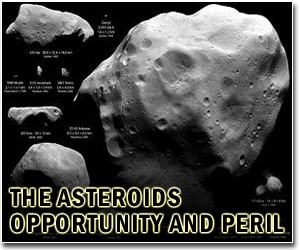
As a U.S. spacecraft nears a rendezvous with the asteroid Vesta, a centuries old debate has reignited — is it an asteroid or should it be considered a planet?
Vesta, orbiting the sun between Mars and Jupiter in the asteroid belt, is larger than most asteroids, which average 60 miles in diameter or less, accuweather.com's astronomy blog reported Wednesday.
At 330 miles in diameter, Vesta has been classified a "minor" planet, a tag it now shares with Pluto since the solar system's ninth planet was "demoted."
A "minor" planet is an object that circles the sun but is neither a proper planet nor a comet.
In June, the NASA Dawn spacecraft will arrive at Vesta, and astronomers hope to get some data to help solve the argument.
"I don't think Vesta should be called an asteroid. Not only is Vesta so much larger, but it's an evolved object, unlike most things we call asteroids," NASA investigator Tom McCord said.
Some researchers favor the term "protoplanet," which they define as a dense, layered celestial body that began to form in the same way as the "normal" planets but never fully developed.
They point to the fact that Vests has a core, mantle and a crust, just like Earth.
"This gritty little protoplanet has survived bombardment in the asteroid belt for over 4.5 billion years, making its surface possibly the oldest planetary surface in the solar system," Christopher Russell of UCLA said. "Studying Vesta will enable us to write a much better history of the solar system's turbulent youth."
Share This Article With Planet Earth
