
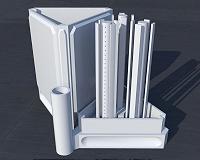
Making objects in outer space has always been a scene from science fiction, but with 3-D printing NASA is making it science fact. In February 2016, Star Trek and NASA challenged students to engineer the future of food in space. After months of designing and modeling, the winners of the Future Engineers 3-D Printing Star Trek Replicator Challenge were selected by a panel of judges from NASA, the American Society of Mechanical Engineers (ASME) Foundation and Made In Space, Inc.
The winner from the Teen Group (ages 13-19) is Kyle Corrette from Desert Vista High School in Phoenix, Arizona, who designed a Melanized Fungarium. The winner of the Junior Group (ages 5-12) is Sreyash Sola from Eagle Ridge Middle School in Ashburn, Virginia, who designed an Astro Mini Farm.
The Future Engineers Star Trek Replicator challenge asked students to boldly go where no one has gone before, using 3-D printing to design solutions that help astronauts "live long and prosper." The challenge was intended for students to think about future long-duration space missions and asked them to design 3-D printable objects that will help astronauts eat nutritious meals in the year 2050.
Examples of student designs ranged from creations that could grow and harvest plants to inventive ideas for preparing, eating and disposing of food. The challenge received 405 submissions representing 30 states.
Corrette's Melanized Fungarium is designed to provide an organic growth bed that can feed astronauts over a long duration. Melanized fungus uses radioactivity as an energy source. Since ionizing radiation is prevalent in space, these fungi could serve as a renewable food source.
The design provides an outer shell, housings for an organic growth bed and an irrigation system. In order to sustain the fungus, water is pumped into the extruding intake tube before travelling through an internal piping network into the growth bed. The device has been crafted for use and production within a microgravity environment, and will function best when printed with a waterproof, low-warp plastic.
Sola's Astro Mini Farm is designed for growing fresh food on Mars to support astronaut health. Being farther away from the sun, Mars gets less sunlight compared to Earth. To address this problem, the Martian Mini Farm has a magnifying glass to collect sunlight and direct it to the plants.
Mars also has a much thinner atmosphere than Earth, so a pump can be added to periodically pressurize the container to about 1/10th the pressure on Earth. It contains a slanted hole in the base to transfer soil into the pot and to water the plants. The Mini Farm doesn't contain electronic parts, which makes it ideal to be created on a 3-D printer using soft glass or transparent material extracted from the Martian soil.
The finalists from each age group are:
Teen Group (Ages 13-19)
+ Kyle Corrette, Phoenix, Arizona – Melanized Fungarium (winner)
+ Ansel Austin, Cupertino, California – Spirulina Farm (finalist)
+ Thomas Salverson, Gretna, Nebraska – Multi-Purpose Mug (finalist)
+ Navya Annapareddy, Haymarket, Virginia – Cosmoaquaponics (finalist)
Junior Group (Ages 5-12)
+ Sreyash Sola, Ashburn, Virginia – Astro Mini Farm (winner)
+ Emily Takara, Cupertino, California – Bioreactor Ornament (finalist)
+ Tobias Platt, Hoboken, New Jersey – Water Condenser (finalist)
+ Owen DuFrene, Portland, Oregon – E-Z Blender (finalist)
Each of the finalists have won a MakerBot Replicator Mini Compact 3-D printer for their school and a PancakeBot for their family. The teen and junior national winners have also been awarded a grand prize trip to New York City to join former NASA astronaut Mike Massimino for a private viewing of the Space Shuttle Enterprise at the Intrepid Sea, Air, and Space Museum, and a VIP tour of MakerBot's headquarters in Brooklyn, New York.
The Star Trek TM Replicator Challenge is the third in a series of Future Engineers 3-D Printing challenges for students focused on designing solutions to real-world space exploration problems.
The challenges are conducted by the ASME Foundation in collaboration with NASA as a joint commitment to the White House Nation of Makers initiative to empower America's students to invent the future by bringing their ideas to life. For additional information on Future Engineers 3-D Space Challenges or to sign up for information on upcoming challenges, visit the Future Engineers Website.
The challenge supports NASA Human Exploration and Operations Mission Directorate Advanced Exploration Systems Division's 3-D Printing in Zero-G ISS Technology Demonstration whose goal is to demonstrate the capability of utilizing a 3-D printer for in-space additive manufacturing technology.
This is the first step toward realizing an additive manufacturing, print-on-demand "machine shop" for long-duration missions and sustaining human exploration of other planets, where there is extremely limited ability and availability of Earth-based logistics support. Advanced Exploration Systems pioneers new approaches for rapidly developing prototype systems, demonstrating key capabilities and validating operational concepts for future human missions beyond Earth orbit.
