
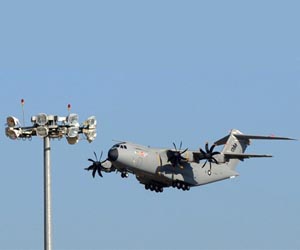
Following long and protracted talks, the European Aeronautic Defense and Space Company and seven European governments struck a deal to save the Airbus A400M plane, Europe's troubled but most ambitious military project.
The deal, brokered by Germany, secures an estimated 10,000 jobs but calls on EADS and taxpayers from the seven countries involved in the project to share the cost of an additional $4.8 billion to cover project expense overruns.
The bailout plan follows threats from the European aerospace company to pull the plug on the project if an agreement to refinance construction of the A400M military transport plane wasn't swiftly reached.
The funding package includes a $2.7 billion increase on the original $30 billion contract, a pass on penalties on current delays and a new delivery schedule, Defense News reported.
Despite the bailout, the deal will have EADS, which competes with U.S. aerospace giant Boeing, posting more than $2 billion in losses for 2009, a company statement said.
Even so, it said the agreement provided for a "sound basis for a successful evolution of the A400M program."
The project was agreed to in 2003 with Airbus ordered to construct 180 A400Ms at a fixed price of $28.7 billion. Technical delays, ballooning costs and political blunders caused delays in the much-vaunted project, with the plane's maiden voyage taking place only last December in Seville, Spain.
The project now is expected to cost around 50 percent more than original estimates.
Germany, the biggest customer of the A400M has ordered 60 units. Other partner governments include France, Britain, Belgium, Luxembourg, Spain and Turkey.
"EADS will strive to identify opportunities to significantly reduce risks in the A400M program and deliver a state-of-the-art product within the new frame of the contract," a company statement said.
Airbus claims the A400M, which uses the largest turboprop engines ever fitted on a Western aircraft, will be capable of carrying double the load of its top competitor, the Lockheed Hercules. Its fuel-efficient power plants will also make it cheaper to operate, compared to the C-17, military experts say.
With its ability to fly in and out of uncharted airstrips, the plane is viewed as a strategic asses for European nations that have long been hampered by shortfalls in military airlift capabilities.
Share This Article With Planet Earth
