
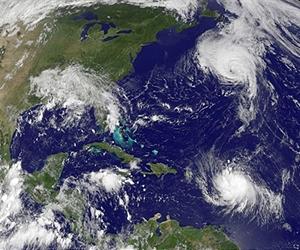
Downgraded to a post-tropical storm, Earl whimpered away from the Canadian coast on Sunday but still managed to knock out power to nearly one million people in the northeast of the country.
The storm was about 190 kilometers (120 miles) off the coast of Newfoundland and Labrador, moving northeast, the Canadian Hurricane Centre said, suggesting it would weaken and be absorbed by a larger depression.
The once-massive storm packed winds of up to 65 miles (100 kilometers) per hour, but that was less than half the power Earl had when it registered category four status on Monday.
Earl weakened dramatically after making landfall in Canada on Saturday as a category one hurricane but Nova Scotia Power said 80,000 homes were still without electricity on Sunday.
Earl also appeared to have claimed one victim, a man who died on Saturday afternoon in Nova Scotia after falling out of his boat. The man had been wearing a life jacket and an autopsy would be carried out to determine his cause of death, authorities said.
Earl's center made landfall in southern Nova Scotia shortly after 11:00 am (1400 GMT) on Saturday, but the Canadian Hurricane Centre later said its strength steadily fell as it buffeted the craggy coastline.
Earlier in the week, Earl had lashed several hundred kilometers (miles) of the eastern US seaboard with heavy rains and strong winds, disrupting holiday plans for millions and prompting evacuations in North Carolina.
It prompted hurricane warnings in the northeastern US state of Massachusetts, notably its vacation destinations including Cape Cod and the tiny islands of Nantucket and Martha's Vineyard.
But while residents battened down the hatches, the storm dealt the region only a glancing blow.
"We had a lot of hype but no action, which was good," the wife of a former attendant at the historic Chatham Lighthouse on Cape Cod told AFP Saturday.
"It's over. There's blue sky, sunshine, very little rain," said the woman who identified herself only as Mrs Davis, adding that winds and rain were strong overnight but did not cause major damage.
Weather watchers said Earl was the most powerful storm to threaten the US Northeast since 1991, when Hurricane Bob killed six people.
earlier related report
Earl loses tropical storm status after soaking Canada
Montreal (AFP) Sept 5, 2010 –
Earl lost its tropical storm status over Canada late Saturday, US government forecasters announced, but the storm still left one person dead and nearly one million people without power in northeastern Canada.
The storm also menaced the US East Coast but left it largely undamaged. "Earl is now post-tropical, and weakening is expected during the next 48 hours," the Miami-based National Hurricane Center said.
Early Sunday, the center of the storm was located 180 miles (295 kilometers southwest of Mary's Harbour, in the Canadian region of Labrador, the NHC said.
It was packing sustained winds of 65 miles (100 kilometers) an hour and moving north-northeast at 46 miles (74 kilometers) an hour.
The center of the storm made landfall in southern Nova Scotia shortly after 11:00 am (1400 GMT) on Saturday, but the Canadian Hurricane Centre (CHC) later said its strength steadily fell as it buffeted the craggy coastline.
Although weakened, Earl still pounded Halifax, the region's largest city, with high winds and rain.
By late afternoon, one man was killed after falling off his boat in Nova Scotia and some 210,000 homes and 940,000 people in the region were without power.
Greater Moncton International Airport canceled all flights Saturday, and Halifax Stanfield International Airport was under partial operation.
Earlier this week, Earl lashed several hundred kilometers (miles) of the US East Coast seaboard with heavy rains and strong winds, disrupting holiday plans for millions and prompting evacuations in North Carolina.
It had also prompted hurricane warnings in the northeastern US state of Massachusetts, notably its vacation destinations including Cape Cod and the tiny islands of Nantucket and Martha's Vineyard.
But while residents battened down the hatches, the storm dealt the region only a glancing blow.
"We had a lot of hype but no action, which was good," the wife of a former attendant at the historic Chatham Lighthouse on Cape Cod told AFP Saturday.
"It's over. There's blue sky, sunshine, very little rain," said the woman who identified herself only as Mrs Davis, adding that winds and rain were strong overnight but did not cause major damage.
Authorities were clear: coastal communities dodged a bullet.
"We're ecstatic it didn't happen," Craig Fugate, chief of the US Federal Emergency Management Agency (FEMA), told reporters, referring to the expected devastation.
US communities suffered "very minimal impacts," with no reports of fatalities, he said, and states were shutting down their emergency management centers.
Residents of North Carolina were mopping up after a storm surge flooded roads on the low-lying barrier islands, as the high winds caused sporadic power outages.
Local residents hunkered down along the beach paradise's commercial spine, Route 28, parallel to the Atlantic.
They awoke to sunshine on Saturday, and quickly began pulling down plywood from storefront windows.
"We were really ready to get blasted, but we got lucky," said Ray Coombes, a recreational sailor who summers in West Yarmouth on Cape Cod and removed his boat from the water Thursday in anticipation of the storm.
Weather watchers said Earl was still the most powerful storm to threaten the US Northeast since 1991, when Hurricane Bob killed six people.
But it left balmy weather in its wake on the US coast.
On the beaches by Hyannis and Yarmouth, which were empty Friday, Labor Day holiday crowds were returning for some end-of-summer sand and sunshine.
"The beach is perfect today," said Sharon Patterson, who was visiting Smuggler's Beach in South Yarmouth with her three children.
Fugate, however, cautioned that the United States was still 87 days away from the end of hurricane season.
"As FEMA resets from Hurricane Earl… we continue to keep an eye on the tropics."
Share This Article With Planet Earth
