
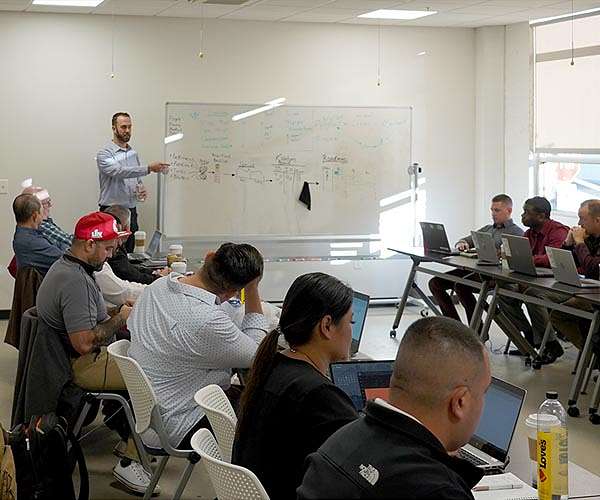
The Refinery program, an initiative of AFWERX's Spark division, is addressing the Chief of Staff of the Air Force's, or CSAF's, Action Orders and the Secretary of the Air Force's, or SECAF's, Operational Imperatives, or OIs, as it works to rapidly advance the projects of Airmen and Guardians. The principal objective of this four-week, hybrid innovation Accelerator program is to target grassroots efforts and further develop tactical project prototypes that directly aid warfighters and ultimately adopt the right operational capabilities into the larger force.
"We are taking a deliberate approach with AFWERX 3.0 to single out opportunities for innovation that are most applicable to OIs and Action Orders," said Col. Elliott Leigh, director of AFWERX.
The Action Orders represent CSAF's call to accelerate change and were updated in February 2022 to detail what the force must do in four focus areas – Action Order A: Airmen; Action Order B: Bureaucracy; Action Order C: Competition; and Action Order D: Design Implementation – in order for the U.S. to remain the most dominant and respected Air Force in the world.
The Refinery assists Airmen in making a meaningful impact on the force and sharpening the nation's competitive advantage, addressing Action Order A.
Maj. Loren Faire of Morpheus, an innovation team under the Vice Chief of Staff of the Air Force Gen. David W. Allvin, has been assigned to the Refinery program to focus on maturation and sustained integration. Regarding Action Order B, Bureaucracy, Faire said the Refinery framework helps to bridge gaps where there were once bureaucratic blockades, encouraging offices to seriously consider or even adopt wholesale the ideas and solutions that these Airmen and Guardians have developed, thus altering the current culture and practices which prevent timely and effective decisions.
The Refinery clearly addresses the action order regarding competition since each project has the potential to save thousands of manpower hours, allowing Airmen and Guardians to focus on higher-order tasks. This might be accomplished through helping servicing jets faster with improved maintenance techniques or integrating a communication system where connectivity is limited. Each diverse project that moves through the Refinery's accelerator program can increase the competitive edge of the U.S.
Lastly, the Refinery caters to Action Order D, Design Implementation, by helping headquarters connect with the teams executing missions. For example, a recent software program by Brett Sheffer called LINKS (Learning Integration Network Knowledge System) completed the Refinery process with 16,000 hours of use and experience, making it a strong candidate for integration into the larger force.
In addition to the CSAF's Action Orders, SECAF Frank Kendall's OIs are the critical operational capabilities and functions the Department of the Air Force must invest in to protect the U.S.' ability to deter conflict and project power against pacing challenges. The AFWERX Refinery program's process and resulting capabilities have been designed to both directly and indirectly support each of these OIs. Notably, Faire called out the Refinery team's focus on targeting OIs 5 and 7, working with Airmen and Guardians to ensure they have the resources and readiness for an agile and modern environment.
"This is the next iteration of taking ideas from both our Airmen and our Guardians, and in the near future our top performers in the SBIR portfolio," said Col. Martin Salinas, division chief, AFWERX Spark. "We are deliberately curating the team leading the innovation to ensure we are supporting the innovation, as well as discovering and removing roadblocks to transition to assist seamless adoption."
Stay tuned for part three of this series, which will spotlight several successfully-transitioned Refinery projects. To learn more and submit project ideas to the Refinery, visit here.
