
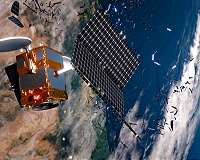
Space debris is a hazard to our satellites and spacecraft as well as a contributor to near-Earth space pollution. To help raise awareness of this issue, ESA's Education Office is organising the first ESA Academy Space Debris Training Course.
The Space Debris Training Course will be hosted at the ESA Academy's Training and Learning Centre in ESEC, Redu, Belgium, from 16 to 20 April 2018. University students will be provided with an introduction to the concept of space debris, why it is necessary to address this problem, and how the mitigation policies set by ESA apply to missions.
Participants will not only learn about the space debris environment and mitigation technologies, but also about how it impacts spacecraft operations, and potential future solutions.
Taught by ESA experts mainly from ESA's Space Debris Office, as well as external experts from the sector, the course will be delivered through formal technical lectures complemented with hands-on exercises based on a real-life case study.
This training course is a collaboration between ESA's Education Office and ESA's Space Debris Office, which coordinates ESA's research activities in all major debris disciplines. These include measurements, modelling, protection, and mitigation.
It also implements the space surveillance segment of the Agency's SSA program, operates ESA's collision avoidance system for a fleet of 20 spacecraft, and represents ESA at international bodies on space debris matters such as the IADC (Inter-Agency Debris Coordination Committee) and UNCOPUOS (United Nations Committee on the Peaceful Uses of Outer Space).
Those familiar with air traffic management architectures understand the constraints of aircraft flying in the atmosphere, vehicle dynamics and command and control techniques. Unfortunately, space traffic has many more degrees of freedom and much less control capability.
Add to this the completely uncontrolled nature of space debris and the reality that most debris objects cannot be tracked … read more
