
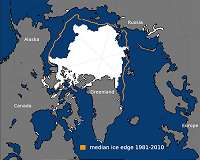
Changes in Arctic sea ice have a direct impact on lower atmospheric conditions in the region, however, possible higher altitude and lower latitude impacts of changing sea ice are less well understood.
Assessing such far-flung affects of Arctic sea ice change from observations is hindered by, amongst other things, the shortness of reliable observational data sets and difficulties in inferring cause and effect in the complex climate system.
New work by Dr Michael Kelleher and Prof James Screen from the University of Exeter, published in Advances in Atmospheric Sciences in a special issue "Towards Improving Understanding and Prediction of Arctic Change and Its Linkage with Eurasian Mid-latitude Weather and Climate", attempts to circumvent these issues by using a large ensemble of model simulations and by examining lead-lag relationships to better elucidate the direction of influence between Arctic sea ice and the atmospheric circulation. They find evidence that sea ice change is both a driver of and a response to atmospheric variability.
The study suggests that midlatitude atmospheric circulation changes appear to precede and could explain changes in Arctic sea ice and a weakening of the polar stratospheric vortex.
The authors argue that whilst low sea ice may further weaken the polar vortex, it appears that in the first instance both the low sea ice and weakened polar vortex are driven by changes in lower latitude weather patterns.
The models reproduce the "warm Arctic, cold continents" winter temperature anomaly pattern seen in the real world. The continental cooling is found one to two months before low sea ice, but is absent in months following low sea ice. This implies that the cooling is not caused by low sea ice, but instead, is driven by atmospheric circulation changes which precede and contribute to low sea ice.
Lockheed Martin strengthens weather forecasting with second next-generation weather satellite
Timely and accurate weather forecasts can directly affect public safety and protection of property; and the next satellite in the NOAA GOES-R Series will continue to provide more data for sharper, more detailed views of weather systems.
NOAA's next weather satellite in the Geostationary Operational Environmental Satellite – R Series, GOES-S, left its Colorado home where it was built and is … read more
