
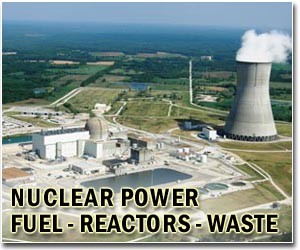
French nuclear group Areva said Tuesday it will set up a system to treat radioactive water from a quake-hit Japanese power plant to allow power supplies and cooling systems to be repaired.
The 9.0-magnitude earthquake and tsunami that hit the northeast coast of Japan on March 11 knocked out power systems at the Fukushima Daiichi plant, causing cooling systems to fail and triggering a series of explosions.
To prevent a nuclear catastrophe, crews have pumped thousands of tonnes of seawater and later freshwater into the reactors and pools, creating a massive amount of radioactive runoff that is now hindering crucial repair work.
Areva will use a system designed to separate radioactive substances out of the contaminated water, the company's chief executive Anne Lauvergeon told a news conference in Tokyo.
"This is a mechanism to treat contamination. We will inject chemicals into the contaminated water that will cause the radioactive substances to separate out," she said, without giving any further details.
Areva said it had been working with the Tokyo Electric Power Company (TEPCO), which runs the Fukushima Daiichi plant, for three weeks to try to come up with a decontamination system.
Tens of thousands of people living near the 1970s-era plant have been forced to evacuate their homes as radiation has leaked into the air, soil and sea in the wake of the disaster.
TEPCO said Sunday it hopes to reduce radiation leaking from the plant in three months and to achieve "cold shutdowns" of all reactors within six to nine months.
earlier related report
Toshiba cuts sales, operating profit outlook on quake
Tokyo (AFP) April 19, 2011 –
Japan's Toshiba on Tuesday said its sales and operating profit forecast for the financial year ended March would miss earlier projections due to last month's earthquake and tsunami.
The firm lowered its forecasts due to the impact of the March 11 disasters and the power supply problems they triggered, forcing some domestic plants to shut down and lowering production.
"Toshiba's forecast of consolidated sales and operating income will fall short of projections announced on January 31, 2011, due to the impact of the Great East Japan Earthquake," it said in a statement.
Supply chains have been broken and power shortages have hit production across key industries, with the impact of the March 11 disasters threatening to throw an export-driven economy into a temporary recession, analysts say.
Many key component manufacturers are based in the worst-hit regions of Japan, their facilities damaged by the 9.0 magnitude earthquake or inundated by the giant wave that followed.
The shortage of key parts has hit companies worldwide and hit production across Europe, the United States and Asia.
Toshiba said it now expects to post an operating profit of 240 billion yen ($2.9 billion), a four percent decrease from its January forecast for 250 billion yen. It cut its revenue outlook to 6.4 trillion yen from 6.6 trillion.
The electronics giant, whose business spans consumer electronics and nuclear reactors, was forced to close a chip-making factory in Iwate Prefecture in Japan's quake-hit northeastern region, which has since partially resumed production.
Toshiba is the world's second largest maker of flash memory chips used to store data in hot-selling smartphones, tablet devices and various other consumer electronics, after Samsung Electronics of South Korea.
It was also forced to shutter a factory making small liquid crystal display panels at its factory in Saitama Prefecture, north of Tokyo.
The plant partially resumed production on March 28 and is to hit full volume by end of this month.
However, on Tuesday Toshiba also raised its net profit forecast for the fiscal year that ended last month to 135 billion yen, from 100 billion yen predicted in January, citing smaller-than-expected "non-operating" expenses.
It is scheduled to release its earnings for the period on May 9.
Share This Article With Planet Earth
