
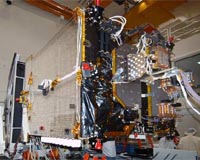
AsiaSat 5 successfully completed Reference Performance testing of the Payload and Bus subsystems. The Spacecraft has been undergoing thermal vacuum testing for a month, and is in the process of completing the last thermal vacuum testing.
Completion of Reference Performance and Spacecraft Thermal Vacuum (SCTV) testing is intended to debug any issue on the spacecraft, and to ensure the bus subsystems meet the performance and environmental requirements for safe on orbit operation.
During SCTV the spacecraft was subject to environmental conditions similar to the space environment of high vacuum and extremes of temperature. The spacecraft was held at temperatures equivalent to Summer Solstice, Winter Solstice and Eclipse for several days at each plateau while payload and bus testing was carried out.
Measurements have shown that the payload meets the demanding AsiaSat specifications. Automatic Level Control of the Ku-band transponders with linearisation has been shown to meet requirements, as also the linearised fixed gain mode.
AsiaSat 5 has a sophisticated Ku-band inter-beam switching which provides great flexibility of usage in orbit. Following thermal vacuum testing the spacecraft will be made ready for dynamics testing comprising acoustic and mechanical vibration.
The antenna tower has been three-axis vibrated and now has many of the antennas attached and is undergoing alignment in parallel to the spacecraft main body testing. The two deployable antennas are in their final fabrication stage and will be ready for spacecraft level integration starting in September.
The spacecraft solar arrays and the batteries have been delivered. The batteries have been placed into cold storage to preserve their high capacity and long life before installation. The solar arrays are undergoing integration into solar array wings and being mechanically tested for initial deployment.
The Design Certification Review (DCR) and the Launch Preliminary Design Review for the AsiaSat 5 Launch, organised by the contracted launch service provider Land Launch, were held respectively on the 9th to 11th of April in Moscow, Russia and on the 14th to 16th of April in Dnepropetrovsk, Ukraine. AsiaSat attended both meetings and deemed them useful and satisfactory. Subsequent to these meetings, the first ever Land
Launch mission for Israel AMOS-3 satellite was conducted successfully on the 24th of April.
AsiaSat 5 will be a replacement for AsiaSat 2 at the orbital location of 100.5 degrees East. Scheduled for launch in 2009, AsiaSat 5 will offer an enhanced pan Asian C-band footprint and a focused East Asia beam, with a very powerful new Ku-band beam over South Asia and a similarly powerful new in-orbit steerable Ku-beam capable of supporting DTH and broadband services in any country within the satellite's coverage area.
