
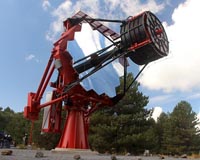
The ASTRI project, led by the Italian National Institute of Astrophysics (INAF), produced the first prototype of a Small Size Telescope (SST) in 2014, now undergoing testing at the Serra La Nave observing station on Mount Etna in Sicily.
On 16th October 2016, the ASTRI telescope prototype, a proposed Small-Size Telescope for the Cherenkov Telescope Array, passed its severest test: demonstrating a constant angular resolution of a few arcminutes (as needed for astronomy with Cherenkov telescopes) over a field of view of ten degrees.
Cherenkov Telescope Array (CTA) is the next-generation ground-based gamma-ray observatory. CTA will have, among its other objectives, the detection of the very highest energy radiation known in the universe, namely, gamma rays with energies as high as 100 tera-electron volts (TeV). To successfully observe these rather elusive cosmic messengers, many relatively Small-Size Telescopes (SSTs), like ASTRI prototype, with a diameter of 4 m, each with good resolution across a wide field of view, will be required.
The technical idea is not new. In 1905, German astrophysicist Karl Schwarzschild proposed a design for a two-mirror telescope intended to eliminate much of the optical aberration across the field of view. This idea, enhanced in 1926 by Andre Couder, lay dormant for almost a century, consigned to suspended animation in specialized journals and texts on astrophysical optics, and considered too difficult and expensive to build.
Much has changed in a hundred years, however: progress in mirror-making technology has made Schwarzschild-Couder telescopes practical and Italian scientists and industry, along with their international collaborators in Brazil, South Africa and Germany, have made them real.
Two weeks ago, the INAF astronomers involved in the ASTRI project presented their results at the CTA Consortium General Meeting at the site of the future headquarters of CTA in Bologna. They hope that ASTRI's demonstrated success will lead to a sub-array of tens of dual-mirror telescopes of SST class at the southern observing site of CTA in Chile, with a precursor mini-array of about a dozen ASTRI clones installed there by 2018.
The ASTRI project, funded by the Italian Ministry of University and Research (MIUR) and by further government funding allocated under the Finance Act of 2015, is led by INAF with the collaboration of a number of Italian Universities, of the Universidade de Sao Paulo (USP, Brazil) and the North-West University (South Africa), the Italian National Institute of Nuclear Physics (INFN) and several industrial partners, in particular EIE, Galbiati Group, Media Lario, Zaot (Italy), Tomelleri srl, BCV Progetti and Flabeg FE GMBH (Germany).
INFN, the Italian National Institute for Nuclear Physics, is studying the triggering scheme of the array for the ASTRI telescopes but is mainly involved in developing innovative light sensors for CTA's Large- and Medium-Size Telescope projects
The CTA project, an international collaboration among scientific institutes from 32 countries, is building an observatory of more than a hundred telescopes to be installed at two observing sites, one in the northern, and one in the southern hemisphere.
CTA will be able to study the sky in the high-energy gamma-ray range with a sensitivity approximately ten times greater than that of existing Cherenkov experiments. The southern site of the observatory will be located in the Atacama Desert of Chile, near ESO's world-class, state-of-the-art optical observatories, the VLT, and the E-ELT, while the northern site will be located in La Palma, Canary Islands.
We asked Giovanni Pareschi, Astronomer at the INAF- Brera Astronomical Observatory and Principal Investigator of the ASTRI project, what are the most innovative aspects of the telescope prototype:
"The telescope was built and completed for the first time ever adopting the Schwarzschild-Couder configuration. This kind of telescope has never been realized until now, mainly due to technological difficulties.
"However, recent advances in technology (in particular for the realization of the primary and secondary mirrors) have made the implementation of this design practicable (thanks also to the study by Prof. Vladimir Vassiliev at UCLA) for the observation of Cherenkov light emitted by the atmospheric showers generated by cosmic gamma rays.
"It is also the first time that a Cherenkov telescope with two focusing mirrors has been completely characterized from the opto-mechanical point of view. It is an important result because it allows us to move immediately to the next step: to mount a Cherenkov camera by December 2016 aiming to observe the first gamma-ray light with the ASTRI dual-mirror telescope."
