
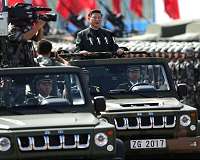
President Xi Jinping has warned that any attempts to split China would result in "bodies smashed and bones ground to powder", amid four months of anti-Beijing unrest in Hong Kong.
Xi issued the dire message during a weekend visit to Nepal, according to a foreign ministry statement released on Sunday.
"Anyone who attempts to split any region from China will perish, with their bodies smashed and bones ground to powder," Xi said, according to the ministry.
"Any external forces that support the splitting of China can only be regarded as delusional by the Chinese people," he said during a visit to Nepal.
While the Chinese leader did not mention any region by name, his comments came as riot police and pro-democracy protesters clashed again in Hong Kong on Sunday and amid tensions with self-ruled Taiwan.
Rallies erupted in multiple neighbourhoods of the financial hub, with some protesters blocking roads, sabotaging train tracks, and trashing pro-China businesses.
China has accused "external forces" of fuelling unrest in the semi-autonomous city, a former British colony that enjoys rights unheard of in the mainland, such as freedom of speech.
The protests were sparked by opposition to a now-scrapped proposal to allow extraditions to mainland China, but have since morphed into a larger movement for democracy and police accountability.
There have been concerns that China could send in troops to put an end to the unrest, but Beijing has so far said it believes Hong Kong's police force is capable of handling the protests.
Few analysts believe Beijing would risk international condemnation by repeating its 1989 crackdown on pro-democracy demonstrators in Tiananmen Square, when it deployed tanks and troops to quash the uprising, leaving hundreds, perhaps more than 1,000, dead.
Beijing has also hardened its stance with democratic Taipei since President Tsai Ing-wen was elected in 2016, as her government refuses to acknowledge that Taiwan is part of "one China".
Taiwan has ruled itself since the end of a civil war in 1949, but China views the island as its territory and has vowed to seize it — by force if necessary.
Another source of tension is US criticism of Beijing's security crackdown in the northwest region of Xinjiang, where more than one million mostly Muslim minorities are believed to be held in internment camps.
China defends the camps as "vocational education centres" aimed at combating separatism and religious extremism.
Protesters erect 'Lady Liberty' statue on Hong Kong mountain top
Hong Kong (AFP) Oct 13, 2019 –
Pro-democracy protesters hauled a four-metre statue known as "Lady Liberty" to the top of a famous Hong Kong mountain early Sunday, announcing the peak would be its "final resting place".
The statue depicts a female protester in a gas mask, protective goggles and helmet, an umbrella in one hand and a black flag in the other, proclaiming the protest slogan "Liberate Hong Kong, revolution of our times".
It was a regular feature at larger, more peaceful rallies this summer, eliciting cheers when it was wheeled in by volunteers and transported around the city on the back of a truck.
But on Sunday organisers said Lady Liberty had made her final journey as they unveiled her at the top of Lion Rock, a 495-metre peak overlooking a forest of skyscrapers, intimately linked to the city's democracy movement.
Alex, a 32-year-old protester who created the statue, said volunteers used the cover of night to carry the 80 kilogram (180 pound) artwork up the steep path to the summit.
"We had a team of 16 climbing professionals carrying her in two main pieces all the way to the summit while another 16 members carried equipment and supplies," he told AFP, only giving his first name.
"Lion Rock will be the final resting place of the Lady Liberty of Hong Kong," the team said in a statement, adding it would be up to authorities to remove it.
Named because its shape resembles the big cat, Lion Rock has been a symbol of Hong Kong's pro-democracy movement for years with large banners demanding freedoms or criticising Beijing frequently unfurled by hardy protesters.
– 'Lion Rock Spirit' –
"Lion Rock Spirit" is used by Hong Kongers to summarise the city's can-do attitude — as well as its reputation for liberty compared to the authoritarian mainland.
The mountain overlooks Kowloon's densely packed working-class districts where many escaping communist China during the worst excesses of the Mao-era first settled.
During 2014's large pro-democracy protests, demonstrators unfurled a huge yellow banner down one of the rock's cliff faces, linking the mountainside to modern-day acts of civil disobedience.
In September, during a mid-Autumn festival, hundreds of protesters gathered on Lion Rock and other peaks surrounding the city shining laser pens and lanterns.
Alex, Lady Liberty's creator, said it was inspired by the "Goddess of Democracy" statue that pro-democracy protesters erected in 1989 inside Tiananmen Square before China crushed the movement.
A version of the Goddess of Democracy is a feature of the annual 4 June Tiananmen vigils in Hong Kong, the only place in China where commemorations of the crackdown can still be held.
But with the international finance hub rocked by its own unprecedented protests aimed at halting sliding freedoms under Beijing's rule, activists wanted to create a Hong Kong version of the Goddess of Democracy.
Much like the protests themselves — which are leaderless and organised online — the design for Lady Liberty was crowd-sourced.
"We invited design proposals on LIHKG, organised a universal vote asking people to pick their favourite design," Alex said, referencing the most popular forum for Hong Kong protesters.
Asked why they had chosen Lion Rock to be the statue's final journey, he said it was "a symbolic gesture to infuse a refreshed mindset for the fight for democracy".
The mountain and the statue, he added, represented "the fundamental values and beliefs" of the protest movement.
