
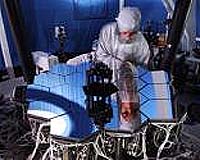
A team of engineers from Ball Aerospace and Technologies Corp. and NASA have successfully met the criteria needed to demonstrate Technology Readiness Level 6 (TRL-6) for the Wavefront Sensing and Control for the James Webb Space Telescope, a measure used by NASA to assess the maturity of evolving technologies.
Space Telescope Testbed, designed to mature the telescope's critical subsystems and reduce risk, was used to demonstrate the critical end-to-end Wavefront Sensing and Control process. A TRL-6 level rating means a system has been tested successfully in a relevant operational environment.
This milestone proves the maturity of sophisticated image process and control software that will be needed to bring JWST into alignment following launch.
Ball Aerospace is the principal optical subcontractor for the JWST program, led by prime contractor Northrop Grumman Space Technology, under a contract from the NASA Goddard Space Flight Center, in Greenbelt, MD.
The software and algorithm technology that achieved this major milestone was developed by a team of engineers from Ball Aerospace, NASA's Goddard Space Flight Center, and the Jet Propulsion Laboratory.
The size of the JWST telescope requires that it be launched in a stowed or folded configuration and unfolded following space deployment. As a result, the primary and secondary mirrors will be aligned on orbit, making the accuracy of JWST's WFS&C all the more critical.
Once on orbit, imagery from a science camera aboard JWST is down-linked to Earth, where algorithms determine the optimal positions for the 19-mirror segments (18 primary mirror segments plus the secondary mirror). Resultant commands are then up-linked to phase the telescope.
"The same technological ingenuity Ball Aerospace applied to correcting the Hubble Space Telescope's primary mirror in 2002 is being applied to advancing the optics for the JWST observatory," said David L. Taylor, president and chief executive officer of Ball Aerospace and Technologies Corp.
The 6.6-meter JWST is designed to study infrared light from objects that formed in the beginning of the universe. It will be the first civilian space-based observatory to use an actively controlled, segmented mirror architecture when launched in 2013. The primary mirror segment assembly passed the milestone necessary to demonstrate Technology Readiness Review 6 in 2006.
