
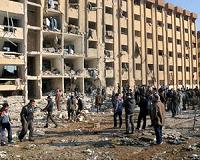
United Nations Secretary-General Ban Ki-moon condemned rebels Friday for cutting water supplies to the besieged northern Syrian city of Aleppo, calling for services to be restored immediately.
Ban's office said water supplies had been cut for eight days, depriving at least 2.5 million people of access to water safe for drinking and sanitation.
Al-Qaeda's Syrian branch, Al-Nusra Front, was among the rebel groups that cut the supplies, though the Red Crescent said that some services had been restored.
Ban "notes that preventing people's access to safe water is a denial of a fundamental human right," his office said.
"Deliberate targeting of civilians and depriving them of essential supplies is a clear breach of international humanitarian and human rights law."
Ban called on all parties to "ensure that the water supply in Aleppo — and everywhere in Syria — is permanently restored and to refrain from targeting civilian facilities and infrastructure," the statement added.
Rebel rocket fire killed 13 people in Aleppo earlier, while troops launched an offensive on rebels in Daraa province of southern Syria, state media said.
The Syrian Observatory for Human Rights also reported the bloodshed in Aleppo and said a large-scale army operation was under way in Daraa for control of hills held by rebels.
UN council to vote on taking Syria before criminal court
United Nations, United States (AFP) May 16, 2014 –
The UN Security Council is expected to vote Thursday on a resolution to haul Syria before the International Criminal Court, although Russian and Chinese opposition will likely doom the measure.
If China and Russia exercise their veto power, it would be the fourth time they do so on Western resolutions since the start of the Syrian crisis three years ago.
The text drafted by France aims "to send a message that there is accountability for the crimes committed in Syria," a diplomat said.
"There is a clear need to demonstrate that the international community is interested in accountability."
Next week's Security Council vote comes amid growing suspicions that Syria has been using chemical weapons on its own people.
"It's not because there is a risk of veto that we should encourage impunity for (Syrian President) Bashar" al-Assad, French Foreign Minister Laurent Fabius said Thursday during a meeting in London of the Friends of Syria group, which backed the French proposal.
Western powers have decried mounting atrocities by the Syrian government on civilians said to include systematic torture, chemical attacks and the use of "barrel bombs" packed with explosives.
The conflict in Syria so far has killed 150,000 people and displaced nearly half the population, as the government employs what one diplomat called "starvation and siege tactics" against its people.
Human Rights Watch said in a report earlier this week it had gathered evidence showing the Damascus government put chlorine canisters inside the barrel bombs it dropped from helicopters on opposition-held towns in northern Syria.
In an effort to gain maximum support, the draft resolution condemns both the government and armed rebels for the violence.
It expresses the council's "strong condemnation of the widespread violations of human rights and international humanitarian law by the Syrian authorities and pro-government militias."
The draft also assails "human rights abuses and violations of international humanitarian law by non-state armed groups."
But many diplomats said they anticipate that Russia would reject the measure in the Security Council, which requires at least nine yes votes for approval, and no veto from any of the council's five permanent members — Britain, China, France, Russia and the United States.
Moscow has already indicated it opposes the measure.
"We believe you need to build a positive momentum," said Moscow's ambassador to the United Nations Vitaly Churkin, who voiced concern that the vote could "exacerbate" differences among parties within the council.
