
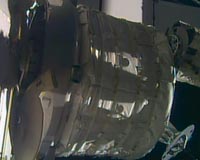
Following extraction from Dragon, the Bigelow Expandable Activity Module (BEAM) was installed to the International Space Station at 5:36 a.m. EDT. At the time of installation, the space station was flying over the Southern Pacific Ocean. It will remain attached to station for two-year test period.
NASA is investigating concepts for habitats that can keep astronauts healthy during space exploration. Expandable habitats are one such concept under consideration – they require less payload volume on the rocket than traditional rigid structures, and expand after being deployed in space to provide additional room for astronauts to live and work inside.
BEAM will be the first test of such a module attached to the space station. It will allow investigators to gauge how well it performs overall, and how it protects against solar radiation, space debris and the temperature extremes of space.
In late May, BEAM will be filled with air and expanded to its full size. Astronauts will enter BEAM on an occasional basis to conduct tests to validate the module's overall performance and the capability of expandable habitats. After the testing period is completed, BEAM will be released from the space station to eventually burn up harmlessly in the Earth's atmosphere.
Meanwhile, ahead of BEAM's deplyoment, the six-member Expedition 47 crew kept up its very busy pace of advanced space research this week to benefit life on Earth and crews in space.
More eye checks were on the schedule today as scientists continued exploring vision changes astronauts have experienced while on orbit.
The crew also observed skeletal muscle cells with a microscope to help researchers identify gravity sensors that may prevent muscle atrophy in space. Saliva samples were collected for a Japanese experiment analyzing how an astronaut's immune system adapts to long-term space missions.
The crew set up software for an experiment recording an astronaut's cognitive performance during stressful conditions in space. They also answered questions about their station habitat providing insights to engineers to help them design spacecraft to meet the needs of future crews.
