
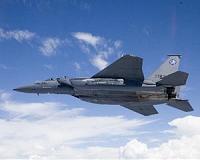
Boeing was awarded a $91.2 million contract new high-speed computer processor for the U.S. Air Force's F-15 fighter jets.
The contract exercises an option for production and integration of the Advanced Display Core Processor II boxes into the F-15 platform initial production, the Defense Department announced Monday.
Work will be performed at Boeing's plant in St. Louis and is expected to be complete by Dec. 28, 2021.
Fiscal 2018 and 2019 procurement funds in the full amount have been obligated at the time of award.
In September 2018, the Air Force initially awarded an $85.5 million contract for the ADCPII on F-15 jets.
Arguably the fastest computer in a fighter jet, the ADCPII is capable of processing 87 billion instructions per second of computing throughput, according to Boeing. This means faster and more reliable mission processing capability for pilots and crews.
The F-15E, with its new computer, made its first flight July 8, 2016, at Florida's Eglin Air Force Base.
"It will bring people home in bad situations – situations we couldn't have gotten home from before," Maj. Justin "Astro" Elliott, who was at the jet's control, said in a news release.
Boeing said the increased processing capability is critical to new advanced capabilities that include Eagle Passive/Active Warning Survivability System, long range infrared search and track capability, high speed radar communications and future software suite upgrades.
"ADCP II brings next generation high-speed computing to the F-15," said Lt. Col. Michael Casey, with Air the Force Life Cycle Management Center at Wright-Patterson Air Force Base in Ohio. "This capability allows pilots to prosecute targets with ironclad precision and sets the foundation for future growth."
The F-15 has been produced in the single-seat A model and two-seat B versions. The two-seat F-15E Strike Eagle version is a dual-role fighter that can engage ground and air targets.
In all models, more than 1,500 F-15s have been built, according to Boeing.
Last September, Boeing was awarded a contract with an estimated ceiling of $9.2 billion for advanced pilot training aircraft and ground-based training systems. It included 351 aircraft, 46 associated training devices, and other ancillary supplies and service.
