
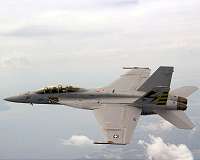
Lockheed Martin has received a contract for the second phase of development and testing for the F/A-18E/F Super Hornet Block II Infrared Search and Track program for the U.S. Navy.
The award, announced Monday by Lockheed, was placed by the prime Super Hornet contractor Boeing and will include development, integration and flight testing of the IRST21 Block II sensor package.
The IRST21 sensor uses infrared to locate and track airborne targets in radar-denied environments, or when a passive system is needed to avoid detection.
IRST21 is currently mounted on the F/A-18E/F's centerline fuel tank, and has seen use in an underwing pod version on the F-14 Tomcat, now retired, and the F-15 Eagle and F-16 Fighting Falcon.
The IRST autonomously detects and tracks airborne targets at long ranges, and can merge the data with the fighters' other sensors to provide a multi-dimensional view of threats. Its passive operation allows target detection and tracking without giving away the plane's location and identification with detectable radar transmissions.
The F/A-18 Super Hornet is the primary carrier- and land-based multi-role fighter of the U.S. Navy and Marine Corps. It has been widely exported and is expected to serve for decades to come alongside the F-35. The E/A-18G Growler is an electronic warfare jamming and anti-radar variant of the series.
Serbia accepts first light attack helicopter from Airbus
Washington DC (SPX) Nov 26, 2018 –
Serbian Minister of Defence Aleksandar Vulin has accepted the first H145M helicopter for the Serbian Air Force at the Airbus Helicopters Donauwarth site in Germany.
The delivery, announced by Airbus on Friday, is the first of nine helicopters Serbia is set to receive from the company.
Two more H145Ms are planned to be delivered to the Serbian Ministry of Interior in December, and four will eventually be delivered to the Serbian air force equipped with the HForce weapon management system designed for light attack roles.
"We assess the implementation of the contract as an example of successful cooperation and positive business practice," Vulin said at a ceremony marking the delivery.
"We are particularly pleased to point out that the activities of the industrial cooperation covered by the contract are taking place within the planned timelines," Vulin added.
The contract involves technology transfers, spare parts, tools and other maintenance equipment along with certification of the Serbian Moma Stanojlovic aircraft plant to maintain them and Gazelle light helicopters. Serbia and Airbus plan to make the plant a supplier for export of parts and services for the helicopters.
The Н145M can come with several kinds of modular payloads that are installed or removed depending on the mission. It is a digitally controlled twin-engine helicopter already in use by Germany, Hungary and other countries. Airbus claims that it is the quietest helicopter in it's size-class, making its approach harder to detect at low altitude.
It can function as a general purpose utility helicopter or be outfitted for surveillance, medical evacuation, search rescue and armed reconnaissance.
The Serbian H145s will have cameras, ballistic panels for light armor, fast ropes and fire support systems, as well as electronic countermeasures.
HForce is a weapons management system designed to outfit military and civilian helicopters as light attack platforms, including rockets, machine guns, guided missiles and targeting pods.
