
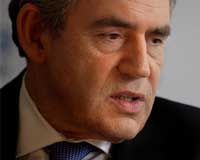
British troops are doing a "vital" job in Afghanistan, Prime Minister Gordon Brown said Sunday, despite controversy over their role as four fatalities pushed the British military death toll past 200.
Amid a spike in violence ahead of Thursday's Afghan presidential elections, Brown said Britain would not give up, even though the bloody milestone has revived questions about the purpose and resourcing of the mission.
Three soldiers, from the 2nd Battalion The Royal Regiment of Fusiliers, died Sunday following an explosion while on patrol near Sangin in southern Helmand province, the Ministry of Defence said.
Another soldier, also from The Royal Regiment of Fusiliers, succumbed to injuries sustained while out on foot patrol Saturday also near Sangin, the ministry said earlier.
Ahead of the three latest casualties, Brown reinforced the importance of Britain's role in Afghanistan and said the government would give troops "all the support that they need to succeed in this vital mission".
"In these moments of sorrow and sadness, we must never forget why we are in Afghanistan and why people are making the sacrifice that they are making," Brown also said.
"Three-quarters of the terrorist plots that hit Britain derive from the mountain areas of Pakistan and Afghanistan and it is to make Britain safe and the rest of the world safe that we must make sure we honour our commitment."
Relatives of those killed since 2001 in the war against the Taliban insurgency called for British troops to pull out, with one saying the deaths so far had been "effectively pointless".
A total of 204 British troops have now died in Afghanistan since 2001, out of a total of 1,312 for all international forces including 782 from the United States and 127 from Canada, according to the icasualties.org website.
A soldier who died on Saturday had brought the toll to 200.
Thirty-two British troops have been killed since the start of July, a spike that followed the launch of Operation Panther's Claw in the build-up to the presidential elections.
"This is indeed a heavy price to pay," NATO Secretary General Anders Fogh Rasmussen.
"Even in this time of sadness, I hope people can understand that these losses are suffered in a cause vital to the security of each of the 42 nations who comprise the NATO-led ISAF," he said Sunday.
"NATO's resolve will remain strong in the challenging months ahead."
The latest deaths have focused the public's mind on the role played by Britain, whose commitment to Afghanistan — second only to the United States — has gradually been growing.
British troop levels now are at their highest yet — 9,150, up from 8,300 in April. Overall there are more than 100,000 international soldiers in Afghanistan, nearly two-thirds of them American.
Colonel Richard Kemp, commander of British forces in Afghanistan between 2003 and 2004, called the 200th death "a very significant milestone".
"I think there will be questions asked about whether what we're achieving in Afghanistan, and what we're hoping to do in Afghanistan is worth this number of British soldiers lives," he told the BBC.
Relatives of the dead were among those asking such questions.
Graham Knight, whose son Ben died when a Royal Air Force Nimrod patrol aircraft exploded over Afghanistan in 2006, said it was time for a pullout.
"There is talk that there could be a military presence for the next 40 years," he said.
"It sends a cold shiver down my spine. We are ill-equipped and ill-advised — we should be getting the non-militant Taliban around the table and begin talks so we can embark on a withdrawal."
Anthony Phillippson, whose son James died in a firefight with the Taliban in 2006, said the death of all troops had been "effectively pointless", adding it was "immoral ministers have left troops so inadequately equipped".
Share This Article With Planet Earth
