
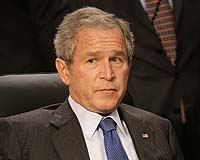
President George W. Bush has ordered a review of US strategy in Afghanistan, a senior Pentagon official said Wednesday, amid rising insurgent violence and tensions with Pakistan.
The review is being led by Lieutenant General Douglas Lute, a deputy national security adviser, with the participation of senior representatives from the Pentagon and other departments, the official said, speaking on condition of anonymity.
"Clearly this seems to be a larger, more cross-governmental approach to what we do here on a regular basis," the official said, referring to the Pentagon and its regular reviews of military strategy.
"I think we're trying to get everything in order and make sure were on a footing for long-term success," he said.
With only months left to the current administration, the White House wants to move quickly, the official said.
"I wouldn't necessarily assume that there is going to be a complete new strategy. That's what's being considered. Are these things that require adjustments?" he said.
It comes amid growing concern in the military and elsewhere over signs that insurgent groups operating from safe havens in Pakistan have coalesced and gained strength over the past two years.
Admiral Michael Mullen, the chairman of the Joint Chiefs of Staff, told lawmkers earlier this month he was not convinced that the United States was winning.
He said he had commissioned a strategy review by the Joint Staff that would encompass not just Afghanistan but Pakistan as well.
The Pentagon official said the Joint Staff has participants in the White House review, along with senior Pentagon officials responsible for policy in Afghanistan and Pakistan.
He said there was broad support for an approach that "doesn't look at Afghanistan as an island, but looks at it in connection with Pakistan."
"The problems we are seeing in (eastern Afghanistan) are directly attributable to what is going on the other side of the border," he said.
related report
NATO troops must take on Afghan drugs trade: commander
Senior NATO commander General John Craddock called for alliance troops to step up the fight against Afghanistan's drugs trade as he ended a three-day visit to the country Wednesday, his office said.
Craddock, the alliance's Supreme Allied Commander for Europe, was in Afghanistan for an "operational update" and to meet troops in the NATO-led International Security Assistance Force (ISAF), it said in a statement.
"As an interim measure I've asked for expanded authority from NATO to permit ISAF attack of drug laboratories and drug trafficking facilities — not the farmers," Craddock was cited as saying during his trip.
Afghanistan produces around 90 percent of the world's illegal opium, much of which is turned into heroin inside the country and exported to Europe, the Middle East and Central Asia.
The United Nations says some of the profits from the lucrative trade fund an extremist insurgency as farmers are often obliged to pay a 10 percent tax to the strongmen in their areas, whether it be Taliban or corrupt officials.
Craddock stressed he was not talking about ISAF troops becoming involved in government-led attempts to wipe out opium poppy fields.
Eradication efforts have cost the lives of at least 65 Afghan soldiers and police this year, according to the Afghan government.
However if soldiers could destroy facilities used to turn opium into heroin, traffickers would be hurt the most and militants and corrupt officials would be deprived their cut of the trade, Craddock said.
He stated that a kilo (2.2 pounds) of opium was worth about 100 dollars, while the same amount of heroin was around 3,500 dollars.
Craddock also challenged concerns from some of the nearly 40 nations with troops in ISAF, whom he did not identify, that an increased counternarcotics role could result in more ferocious attacks on NATO forces.
"This is a totally specious argument," he said.
"What's more ferocious than IEDs (improvised explosive devices) and suicide bombs? If we do this, we'll cut the legs out from under them because they won't have the money to pay the bomb makers and buy the materials to attack us."
Craddock said he was optimistic the North Atlantic Council, NATO's governing body, would approve his request because ISAF's troops were "being killed because of the money being generated from this industry."
"As a commander I can't let this continue without doing everything I can to stop it. This is the best measure we can give our forces for the best opportunity to come home safe and sound," he said.
The UN-mandated ISAF, currently at about 50,000 troops, already helps Afghan counternarcotics forces, including with some air support and medical evacuation if they come under attack.
The head of the United Nations Office on Drugs and Crime, Antonio Maria Costa, last week called for ISAF to target the drugs labs.
"The international forces could destroy these laboratories within 24 hours," he told reporters at a breakfast meeting in Paris.
NATO should "disrupt the supply chain" by attacking drug convoys and markets as well as clamping down on the import of chemicals used to make opium, he said, criticising the reluctance of "European countries" to tackle the problem.
