
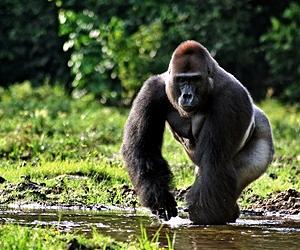
Illegal logging, mining and poaching for bushmeat are pushing gorillas and other great apes in Africa's Congo basin ever closer to extinction, according to a report released on Wednesday.
Earlier estimates that the natural habitat of gorillas could shrink by 90 percent within two decades now seem overly optimistic, said the report, compiled jointly by the UN Environment Programme (UNEP) and international police organisation Interpol.
"With the current accelerated rate of poaching for bushmeat and habitat loss, the gorilla of the Greater Congo Basin may now disappear from most of their present range within 10 to 15 years," said UNEP's Christian Nellemann.
Outbreaks of Ebola fever have dimmed survival prospects even further, said the report, launched at a meeting of the Convention on the International Trade in Endangered Species (CITES) in the Qatari capital Doha.
The virus has killed thousands of great apes, including gorillas, with about 90 percent of infected animals doomed to die.
The report, entitled The Last Stand of the Gorilla – Environmental Crime and Conflict in the Congo Basin, points an accusing finger at rebel militias ensconced in the remote reaches of eastern Democratic Republic of Congo.
Much of the environmental damage and hunting is linked to trade — worth hundreds of millions of dollars — in illegally extracted gold, diamonds and precious woods carried out by the militias to fund their conflict, it found.
Insecurity caused by the fighting, meanwhile, has driven hundreds of thousands of people into refugee camps, creating a demand for ape meat as food.
Logging and mining camps with likely links to militia hire poachers to supply refugees and local markets in towns across the region with so-called bushmeat.
"This is a tragedy for the great ape and one also for countless other species being impacted by this intensifying and all too often illegal trade," said Achim Steiner, UNEP's executive director.
"It is environmental crime and theft by the few and powerful at the expense of the poor and the vulnerable," he said in a statement.
Stronger international support for Interpol's Environmental Crime Programme is needed to help overwhelmed local rangers protect the critically endangered gorillas.
More than 190 rangers have been killed in recent years in the Virunga National Park, most likely by militia members seeking unfettered access to the resources they exploit for revenue.
Mountain gorillas are found only on the slopes of the Virungas on the borders of Rwanda, Uganda and the Democratic Republic of Congo, and fewer than 700 individuals remain in the wild, according to the Dian Fossey Gorilla Fund International.
Gorillas have also been vulnerable to traps set for other animals, and females have been killed so that their babies could be sold as pets.
Both Rwanda and Uganda have turned gorilla tracking into a major eco-tourism industry and a big foreign-currency earner. War has stalled similar development in eastern DR Congo.
Share This Article With Planet Earth
