
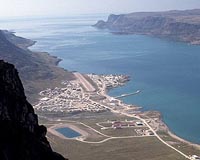
Prime Minister Stephen Harper injected millions of dollars Thursday into fisheries and the construction of a new port as he toured the Arctic to bolster Canadian claims to the region's mineral wealth.
On day four of a five-day visit to the far north Harper said construction of the new harbor in Pangnirtung, a mainstay of the turbot fishing industry in Canada's Arctic territory of Nunavut, would begin in September.
Once completed, this "key outpost on Canada's Arctic shoreline… will give fishermen in the region a modern and reliable base of operations for years to come," he said in a statement.
"This project will (also) further one of the key priorities in our northern strategy."
Seventeen million Canadian dollars (15.5 million US) has been allocated for the project and Ottawa will also provide scientific research and resource management support to the fishery, a statement from Harper's office said.
On Wednesday the prime minister flew a helicopter around an iceberg, sailed a warship, and dove in a navy submarine as he joined military exercises trumpeting Canada's sovereignty over a large Arctic tract east of Baffin Island.
"With other countries probing our north by sea and in the air, the work you are doing here to protect our sovereignty has never been more important," he told sailors on the deck of HMCS Toronto.
"Protecting national sovereignty, the integrity of our borders, is the first and foremost responsibility of a national government."
Five countries bordering the Arctic — Canada, Denmark, Norway, Russia and the United States — claim overlapping parts of the Arctic, which is estimated to hold 90 billion untapped barrels of oil.
Moscow believes it should control the Northern Sea Route, a passage that stretches from Asia to Europe across northern Russia.
In 2007, Russian submariners planted a flag on the ocean floor beneath the North Pole in a symbolic staking of its claim over the region.
Canada, meanwhile, has claimed the famed Northwest Passage, but is at odds with the United States which considers it to be international waters. The two allies also cannot agree on the resource-rich Beaufort Sea, which touches both Alaska and Canada's northern territories.
Since becoming prime minister in 2006, Harper has made Canadian sovereignty over the Arctic a key priority of his government. This is Harper's third trip to the region as prime minister.
Share This Article With Planet Earth
