
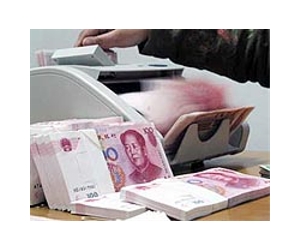
Chinese banks issued 603.4 billion yuan (89.1 billion dollars) in new loans in June, down from May, the central bank said Sunday, as Beijing works to gradually works to cool the economy.
Bank lending in May had reached 639.4 billion yuan, but the government has rolled out a series of measures to restrain the supply of credit for fear of an asset bubble in the booming economy.
The figures meant lending for the first half of the year reached 62 percent of the government's annual target, indicating credit growth will likely slow in the coming months, Dow Jones Newswires reported.
The lending total for June was generally in line with the 600-billion-yuan forecast of nine economists polled by Dow Jones.
M2, the broadest measure of money supply which includes cash and money in savings accounts, rose 18.5 percent at the end of June from a year earlier, which marked a slowdown from the 21 percent increase at the end of May.
China has powered out of the global financial crisis on the back of a four trillion-yuan stimulus package and state-sanctioned bank lending that saw loans nearly double to 9.6 trillion yuan in 2009.
But worried about a potential rise in bad loans and inflation, the government has clamped down on lending and has set a loan target of 7.5 trillion yuan for this year, a 22 percent drop from last year.
earlier related report
IMF urges slow change for China's forex reserves
Hong Kong (AFP) July 9, 2010 –
Any changes in the makeup of China's foreign exchange reserves would have to be very slow, International Monetary Fund chief economist Olivier Blanchard said Friday.
Blanchard's remark to a Hong Kong business lunch came one day after China's finance ministry announced that its investment in Japanese government bonds in May was nearly triple the annual amount it has invested previously.
Chinese investors had bought a net 735.2 billion yen (8.3 billion dollars) in Japanese government bonds in May, more than the 541 billion yen purchased in the four months previously, the ministry said.
The huge increase sparked questions about whether China was moving to shrink its exposure to US government debt in favour of relatively stable Japanese government bonds.
China has sought to diversify its vast investments away from the US dollar and Europe since the onset of the global financial crisis.
Blanchard said the IMF welcomed China's recent move to let its yuan currency trade more freely, although he added that any rise was unlikely to be rapid.
The move followed international calls for Beijing let the currency's value rise over concerns that it unfairly made Chinese exports cheaper.
— Dow Jones Newswires contributed to this report
Share This Article With Planet Earth
