
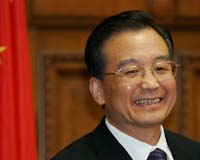
China's economy is strong enough to withstand the impact of the global financial crisis and may even help the world by maintaining fast growth, Premier Wen Jiabao was quoted as saying Sunday.
"Our economic fundamentals haven't changed, and the economy is moving in the direction we expected," Wen was quoted as saying by the state-controlled Xinhua news agency.
"The strength of our financial institutions has generally increased, and their ability to make money and withstand risk has risen. Market liquidity is ample and the financial system is stable and safe," he said.
"This will help us withstand any negative external impact. We're full of confidence in the development of the economy, and in the stability of the financial system."
Wen, who made the remarks during an inspection tour to south China's Guangxi Zhuang region, said the best way his nation could help would be by ensuring fast economic growth at home.
"If a large country of 1.3 billion people can keep up stable and relatively fast economic growth, that's a big contribution to the world," he said, according to Xinhua.
China welcomes US financial rescue deal
China Saturday welcomed US lawmakers' approval of a 700-billion-dollar financial sector bailout plan, state media reported, quoting a central bank spokesman.
"We are glad to see the passage of the rescue bill by the House of Representatives and the Senate despite earlier twists and turns," the People's Bank of China spokesman was quoted as saying.
"The Chinese government has been closely following the developments of the US financial crisis and its impact," he said.
The official said Chinese authorities "hoped that it would be implemented as soon as possible and achieve positive results," Xinhua reported.
"China and the United States of America share common interests in stabilising a stable financial market," he said.
The US House of Representatives approved the revised 700-billion-dollar package Friday, on its second try, bowing to intense pressure to help avert a global economic meltdown.
The bill, which was quickly signed into law by President George W. Bush, marks the largest US government economic intervention since the 1930s Great Depression.
The bailout gives the US Treasury power to buy up toxic mortgage debt which has been choking the financial industry and would create a 700-billion dollar federal programme to buy bad assets from banks and other financial firms.
