
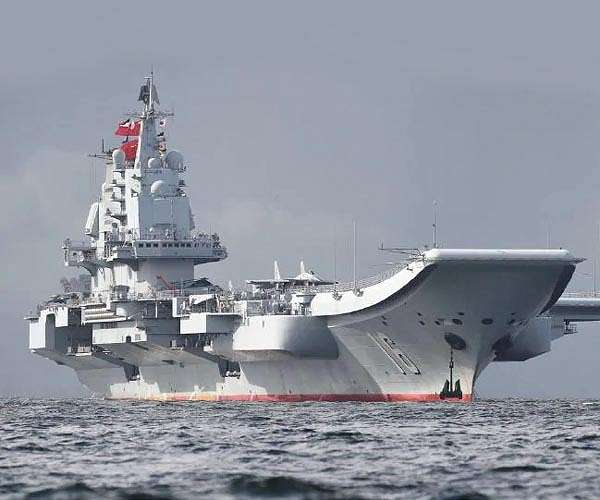
Chinese fighter jets and warships simulated strikes on Taiwan Sunday as they encircled the island during a second straight day of military drills that were launched in response to its president meeting the US House speaker.
The exercises sparked condemnation from Taipei and calls for restraint from Washington, which said it was "monitoring Beijing's actions closely".
Dubbed "Joint Sword", the three-day operation — which includes rehearsing an encirclement of Taiwan — will run until Monday, the People's Liberation Army's (PLA) Eastern Theatre Command said.
"I am a little worried; I would be lying to you if I say that I am not," said 73-year-old Donald Ho, who was exercising in a park on Sunday morning in Taipei, in the far north of the self-ruled island.
"I am still worried because if a war broke out both sides will suffer quite a lot," he told AFP.
China's war games saw planes, ships and personnel sent into "the maritime areas and air space of the Taiwan Strait, off the northern and southern coasts of the island, and to the island's east", the army said as it launched the exercises, engineered to flex Beijing's military muscles in front of Taiwan and the world.
A report from state broadcaster CCTV on Sunday said drills had "simulated joint precision strikes against key targets on Taiwan island and surrounding waters", adding that forces "continued to maintain the situation of closely encircling the island".
The write-up went on to say the air force had deployed dozens of aircraft to "fly into the target airspace", and ground forces had carried out drills for "multi-target precision strikes".
Taiwanese President Tsai Ing-wen immediately denounced the drills, which come after she met with US House Speaker Kevin McCarthy in California.
She pledged to work with "the US and other like-minded countries" in the face of "continued authoritarian expansionism".
In Washington, a State Department spokesperson said the United States had "consistently urged restraint and no change to the status quo", but noted it had ample resources to fulfil its security commitments in Asia.
The United States has been deliberately ambiguous on whether it would defend Taiwan militarily, although for decades it has sold weapons to Taipei to help ensure its self-defence.
– Live-fire exercises –
Exercises on Monday will include live-fire drills off the rocky coast of China's Fujian province, about 80 kilometres (50 miles) south of Taiwan's Matsu Islands and 186 kilometres from Taipei.
"These operations serve as a stern warning against the collusion between separatist forces seeking 'Taiwan independence' and external forces and against their provocative activities," said Shi Yin, a PLA spokesman.
"The operations are necessary for safeguarding China's national sovereignty and territorial integrity."
AFP saw no immediate signs of enhanced military manoeuvres on the northern coast of Pingtan, a Chinese island across the strait from Taiwan where the live-ammunition exercises will kick off on Monday.
A smattering of tourists wandered the golden sands on Sunday morning, as fishing boats bobbed in the wharf beyond.
China views democratic, self-ruled Taiwan as part of its territory and has vowed to take it one day, by force if necessary.
Taiwan's defence ministry said on Sunday it had detected nine Chinese warships and 58 aircraft around the island. On Saturday the same number of ships were tracked, along with more than 70 aircraft.
The ministry said it was monitoring Chinese military "movements through (a) joint intelligence surveillance and reconnaissance system", adding the warplanes detected until 12 pm local time (0400 GMT) included a mix of fighter jets and bombers.
The number of aircraft crossings into Taiwan's southwestern air defence identification zone (ADIZ) on Saturday was the highest recorded in a single day this year, according to data collected by AFP.
"The CCP (Chinese Communist Party) has continued to conduct military exercises around the Taiwan Strait and since this morning it has successively dispatched multiple batches of aircraft… as well as a number of ships in the area," the defence ministry said on Sunday.
"The military has been closely monitoring the situation for relevant developments, and tasked aircraft, ships and ground missile systems to respond accordingly," it added.
The drills came hours after the departure from Beijing of French President Emmanuel Macron, who was in China to urge his counterpart Xi Jinping to help bring an end to the war in Ukraine.
In August last year, China deployed warships, missiles and fighter jets around Taiwan in its largest show of force in years following a trip to the island by McCarthy's predecessor, Nancy Pelosi.
Tsai returned to Taiwan on Friday after visiting her island's dwindling band of official diplomatic allies in Latin America, with two US stopovers that included meetings with McCarthy and other lawmakers.
China's drills around Taiwan: key questions
Beijing (AFP) April 9, 2023 –
China has launched three days of military drills intended to intimidate self-ruled Taiwan after a US visit by Taipei's President Tsai Ing-wen angered Beijing.
Here are some key questions and answers about China's "Joint Sword" operation:
– What are they doing? –
The Chinese military has deployed ships, fighter jets and missiles in the sea around Taiwan to send a "serious warning against Taiwan independence separatist forces", according to state media.
The drills, which began on Saturday, include patrols around the island and the rehearsal of "simulated joint precision strikes against key targets" as well as an "encirclement and deterrence posture" around Taiwan.
"Dozens" of J-18 and J-10C fighter jets have been deployed in the operation, alongside anti-submarine aircraft, according to the official CCTV.
China has also brought out its PHL-191 rocket launcher systems and YJ-12B land-based anti-ship missiles, the state-run Global Times reported.
Taiwan's defence ministry said as many as nine Chinese warships had been detected around the island on Saturday.
– What does China want? –
Despite Taiwan having been ruled separately for more than 70 years, China's communist government considers the island as part of its territory, and has vowed to retake it one day.
Beijing bristles at any official contact between Taipei and foreign governments, including a recent trip by Tsai to the US, where she met US House Speaker Kevin McCarthy and a delegation of politicians from the Republican and Democratic parties.
China's foreign ministry said earlier this week it would take "resolute and effective measures" against the visit.
The ongoing exercises are "part of a broader pattern of pressure targeting Taiwan", said Ja Ian Chong, an associate professor of political science at the National University of Singapore.
But "major visits enable Beijing to pin the blame on Taipei, Washington, or others", Chong told AFP.
– Why now? –
Tsai arrived in California on Tuesday, but Beijing waited to launch drills after her return to Taiwan.
The Chinese leadership has been in a delicate position this week with French President Emmanuel Macron and European Commission President Ursula von der Leyen visiting the country and President Xi Jinping angling to warm up relations with Europe.
James Char, China researcher at Singapore's Institute of Defence and Strategic Studies, told AFP Beijing had likely waited for the departure of European dignitaries before it launched its show of force as "Beijing has been trying to re-engage with the West".
Initiating military operations over Taiwan "will be detrimental to this ongoing diplomatic overture", he said.
– What other measures is Beijing taking? –
China this week also announced new sanctions on Taipei's representative to the United States, as well as two US organisations, in retaliation for Tsai's trip.
Beijing says it will ban Taiwan's de facto ambassador to Washington, Hsiao Bi-Khim, from entering China, and has accused her of "deliberately inciting cross-strait confrontation".
It has also blocked the Hudson Institute, a Washington-based conservative think tank, as well as the Ronald Reagan Presidential Library, from engaging in transactions and cooperation with Chinese entities for hosting Tsai this week.
– How does this compare with previous drills? –
China's response this weekend echoes its fury over a visit to Taipei last August by then-US House Speaker Nancy Pelosi.
At the time, Beijing held live-fire military drills just a dozen miles off Taiwan's shore in what state media called an effort to "seal off Taiwan" that lasted for around a week, while Chinese customs authorities suspended imports of fruit and fish from the island.
This time, Beijing is conducting live-fire drills off the coast of China's Fujian province, about 50 miles south of Taiwan's Matsu Islands.
The latest drills seem "not of the same scale as we saw during Pelosi's visit", said Manoj Kewalramani, China expert at the Takshashila Institution in Bengaluru, India.
Kewalramani noted that Pelosi's visit came in the run-up to Xi's bid for a historic third term in power at last year's 20th Communist Party Congress, and a visit by the House Speaker to what Beijing considered its own territory was on another level from Tsai's recent US visit.
China's priorities may also have shifted slightly, according to Su Tzu-yun, a military expert at Taiwan's Institute for National Defence and Security Research.
After a severe economic blow from three years of strict Covid rules, "the restoration of air and sea routes around Taiwan this year is very important to neighbouring countries and China's own economic recovery, so the intensity of military drills should not increase again", Su told AFP.
Last year's drills had disrupted shipping and air traffic in major shipping lanes around Taiwan.
Su said he believed the ongoing drills were "internal propaganda" aimed at countering domestic criticism that earlier Chinese actions were too weak.
