
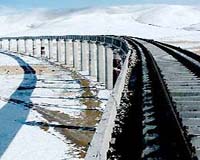
Chinese authorities in Tibet will ban mining of gold and some other resources to ease environmental fears stoked by a new railway line to the once-remote region, state media said Wednesday. The mining of mercury, arsenic and peat also will be banned under a plan being formulated by the mountainous region's Land and Resources Department, Xinhua news agency reported.
"Mercury and arsenic mining can pollute water supplies, peat mining can destroy wetlands and gold mining can ruin grasslands and rivers," it quoted department directors Wang Baosheng as saying.
However, the plan looked unlikely to completely ease fears of an ecologically harmful plundering of the area's resources, voiced by environmental groups and Tibet's government-in-exile led by the Dalai Lama.
In February, state media carried reports of a new survey by China geological authorities that found more than 600 potential sites for new copper, lead, zinc and iron ore mines to help feed China's ravenous appetite for minerals.
China opened its first railway line into Tibet last year, leading to an immediate boost in visitors to the region and fears that its harsh mountainous terrain would no longer protect the area from exploitation.
Chinese troops took control of Tibet in 1951. The Dalai Lama has led a Tibetan government-in-exile in India since 1959 after fleeing a failed uprising against Chinese rule.
Source: Agence France-Presse
