
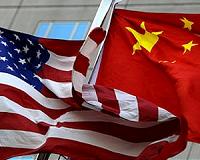
China denied President Xi Jinping's pledge this week to further open the country's economy was related to its trade spat with the United States, insisting on Thursday there were currently no negotiations between the two sides.
Xi on Tuesday vowed ease tariffs and open the economy up more in what was seen as a conciliatory gesture to temper fears of a US trade war after Donald Trump last week threatened fresh levies on billions of dollars of Chinese goods.
The US president welcomed the speech and said he saw an end to the dispute, which has roiled markets since the start of March
But Commerce Ministry spokesman Gao Feng warned Beijing was ready to strike back if the United States presses on with its economic nationalist agenda.
"If the US side takes it own course and insists on carrying out unilateralism and trade protectionism, the Chinese side will fight resolutely and take them on until the end," Gao told reporters at a regular news briefing.
World markets rallied after Xi pledged at an economic forum to lower car tariffs, protect intellectual property and take other steps to open China's economy "wider and wider".
But Gao said the measures are proactive and have nothing to do with the trade frictions between China and US.
"China took the initiative to open up and made it possible for all countries across the world to ride on the express of China's economic development," Gao said.
"We hope some people in the United States don't misjudge the situation."
He added: "Up to now China and the US has not carried out negotiation at any level on the trade frictions. The US side has not shown any sincerity for negotiation in its actions.
"China will not carry out any negotiation under one-sided coercion."
Hong Kong dollar touches red line but no intervention as yet
Hong Kong, China (AFP) April 12, 2018 –
Hong Kong's de facto central bank said it would not necessarily step into the currency market to support the local dollar despite it touching the bottom end of its trading band Thursday.
As trading began in Asia, Hong Kong's dollar fell to HK$7.85 against the US dollar — the lower limit of its permitted HK$7.75-7.85 band — for the first time since the range was introduced in 2005.
The Hong Kong Monetary Authority said it is required to buy the local currency at HK$7.85 to US$1 under the city's Linked Exchange Rate System if such requests were made by banks.
But the authority added that this practice, known as the weak-side Convertibility Undertaking, will not be automatically triggered.
"So long as other banks are willing to buy HKD at that level, the interbank market will continue to buy and sell HKD at 7.85," the HKMA said.
Hong Kong has maintained a decades-old peg with the US dollar, which keeps the city at the mercy of Federal Reserve policymakers.
The dollar slump comes against a backdrop of rising trade tensions between China and the United States, the world's biggest economies and key drivers of global growth.
HKMA chief executive Norman Chan said in March that the weakening local dollar, driven lower by US interest rates and capital outflows "should not cause any concerns" and that the authority would take action to ensure it doesn't fall below the band.
The HKMA intervened in the foreign exchange market in 2008, buying billions of dollars to maintain the local currency's peg to the greenback.
During the 1997-1998 Asian financial crisis several Asian currencies were de-pegged under severe pressure from speculators, but Hong Kong maintained the link despite having to raise interest rates to spectacular levels.
