
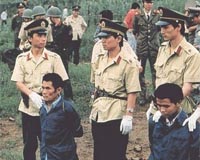
China, which reportedly executes more people than the rest of the world combined, is to introduce tighter rules governing prosecution evidence in death penalty cases, state media said Tuesday.
The chief prosecutor's office, or Supreme People's Procuratorate, will for the first time introduce regulations stating how prosecutors should review such evidence before the cases go to trial, the Beijing News reported.
Prosecutors will be told to dismiss evidence obtained by torture, and interrogators who are suspected of using torture will be investigated and punished, the report said, citing Zhu Xiaoqing, a deputy chief prosecutor.
Speaking at a seminar recently, Zhu also suggested expanding the use of audio and video recordings of interrogations carried out in serious criminal cases.
In recent years, several criminal suspects who were executed were later found to be innocent, causing an outcry over China's controversial use of the death penalty and of forced confessions.
For example, a man was put to death in June 1996 for the rape and murder of a woman in a factory in Hohhot in the northern region of Inner Mongolia, state media reported last week.
But in October 2005, another man was arrested by police and confessed to killing 10 people in the region, including the woman murdered in the factory, the reports said.
China has slowly been reforming its death penalty system after acknowledging several miscarriages of justice.
At the beginning of 2007, the Supreme People's Court began reviewing every death penalty case rather than allowing lower courts to issue the final judgement — a move that China says has led to fewer executions.
In 2008, more than 1,700 people were put to death in China, while at least 2,390 people were known to have been executed in 25 countries around the world, according to rights group Amnesty International.
China does not publish data on executions, and rights groups say the number could be much higher.
Share This Article With Planet Earth
