
Later this year, China will send a spacecraft out to the Moon, then return it to Earth. The uncrewed vehicle will fly around the far side of the Moon and use the Moon's gravity to slingshot it back to Earth. As it approaches the home planet, the spacecraft will release a capsule that will parachute to a soft landing.
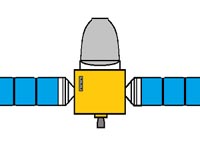
Officially, the mission is designed to test a re-entry capsule to be used in a future robotic lunar-sample return mission. In this analyst's opinion, the mission is also designed to prepare for a future Chinese astronaut launch to the Moon. Filling this information vacuum, I have now prepared a rough diagram of the expected layout of China's first circumlunar spacecraft.
China has slowly trickled out details on this mission, but has yet to release any illustrations of the entire vehicle.
China has disclosed that the main module of the spacecraft is based on the same design as the Chang'e-1 and 2 lunar orbiters. This is a boxy structure that is itself derived from a Chinese communications satellite design. Using this basic structure again makes sense. It has a proven track record on two previous lunar missions.
China has also released photographs of the re-entry capsule. It's a small scale-model of the Shenzhou re-entry module used to launch and return China's astronauts.
There are some solid technical reasons for using this type of design, but the decision to make such a precise copy of the Shenzhou capsule was suspicious. It represents another piece of evidence for the case that China eventually plans to launch a full-scale Shenzhou capsule on a similar mission.
This analyst has found no precise reports of the size of this small capsule, but has formed a rough estimate by examining photographs and comparing the capsule to people standing around it.
Using this rough form of mensuration, this analyst suggests that the capsule has a base diameter of 1.5 metres. This number also has a nice, clean feel from an engineering perspective. It may not be exact, but it's fairly close.
We know the dimensions of the Chang'e spacecraft module exactly, thanks to official Chinese reportage. It's a rectangular prism with sides of 2.2 metres, 2 metres and 1.7 metres. The spacecraft's main engine protrudes from one of the larger rectangular faces of the module.
With this in mind, it makes sense to assume that the capsule would be placed on the rectangular face exactly opposite the engine. This balances the centre of mass of the whole spacecraft from a thrust perspective.
When a 1.5 metre capsule is sketched in this position, it produces a design that looks fairly balanced. This is the basis of the illustration supplied with this article. The capsule must be slightly raised from the module to avoid contact with its fuel tank and other parts.
Is this the real thing? We won't know until China releases more information.
