
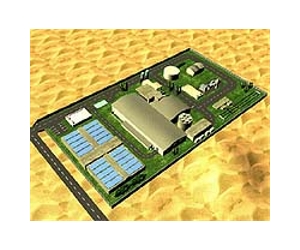
China's major desalination project in Tianjin, while seen as necessary to ease water shortages, hasn't generated the expected demand for the desalinated water since operations started there last April, The Guardian newspaper reports.
The main drawback is the high cost of the water. Desalinated water costs $1.22 a cubic meter, compared with $0.75 for normal Tianjin water.
Even though cheaper water sources in China — pumped from rivers, lakes and aquifers — are rapidly depleting from decades of over-utilization, companies are reluctant to make the transition to desalinated water.
But experts also say that utilities are concerned that once they make the switch to desalinated water, they can no longer use traditional sources.
"They don't want to give up the old resources because they know they won't get permission to use them again," said Wang Shichang, head of the desalination research center at Tianjin University, The Guardian reports. "But the delay won't last long. China is working on plans to further develop desalination because we face scarce water resources and rising demand."
The coastal port city of Tianjin, about 90 miles from Beijing, faces one of the most acute water shortages in China, with its per capita quota of water resources at 370 cubic meters, far lower than the internationally recognized warning level of 1,000 cubic meters per capita.
This month the Tianjin facility raised its daily supply of desalinated seawater by 8,000 cubic meters a day to a total of 30,000 cubic meters a day, state-owned news agency Xinhua reports.
By the end of 2011, the plant's processing capacity is expected to double, said Guo Qigang, general manager of the plant.
Guo Youzhi, head of the China Desalination Association, predicts that the government's next five-year plan, to be announced this spring, is likely to include a target of 2 million cubic meters of desalinated water per day, an increase of 150 percent from current levels.
Market analysts also predict continued growth for China's desalination sector.
"We think China will build an additional 20 plants. They have to," The Guardian quoted Simon Powell, head of sustainable research at CLSA brokerage, as saying.
Still, more needs to be done to solve China's water problems. Just in Beijing, the water shortage is expected to reach 200 million to 300 million cubic meters, state media report.
"All the planned desalination plants will at best supply only half of Beijing's water. It's a drop in the ocean," said Powell.
Share This Article With Planet Earth
