
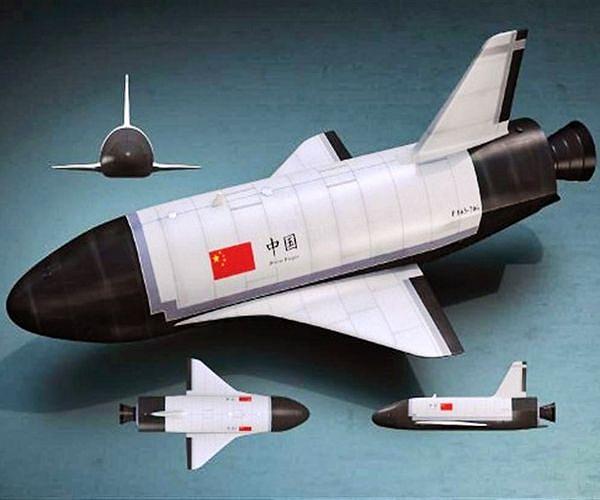
The Chinese reusable experimental spaceship has successfully returned to Earth having spent two days in the orbit, Chinese news agency Xinhua reported on Sunday.
The reusable spaceship was launched this past Friday on a Long March 2F carrier rocket from the Jiuquan Satellite Launch Centre in the Gobi Desert.
While little has so far been known about the reusable capsule, Xinhua said the experiment was successful, which marks a milestone in China's quest to master reusable spacecrafts.
As declared by the China Aerospace Science and Technology Corporation on the day of launch, the spacecraft's mission was "to test the reusable technology during space flight and to provide technological support in peace exploration of space".
The Chinese reusable experimental spaceship was registered in the catalog of space objects under the international designation of 2020-063? and number 46389.
China's Reusable Spacecraft Blasts Off for First Time in Secretive Launch
China's first reusable spacecraft was blasted into space on Friday morning from the Jiuquan Satellite Launch Center in the Gobi Desert. According to a government aerospace agency, the mission will prepare the Chinese space program for a new generation of manned space missions.
The reusable spacecraft blasted off early Friday morning atop a Long March-2F carrier rocket, China's Xinhua News Agency reported. The outlet noted, "After a period of in-orbit operation, the spacecraft will return to the scheduled landing site in China. It will test reusable technologies during its flight, providing technological support for the peaceful use of space."
Very little is known about either the vehicle or the launch. Commenting on an official memo obtained by the South China Morning Post that told staff and visitors not to film the launch or discuss it online, an anonymous military source told the outlet: "There are many firsts in this launch. The spacecraft is new, the launch method is also different. That's why we need to make sure there is extra security."
However, the source hinted it was similar to the X-37B, an experimental Orbital Test Vehicle built by the US that is also reusable – and shrouded in similar secrecy. The X-37B is also currently in space, having departed for its sixth mission in May.
The X-37B is an unmanned craft, but China's might not be. According to a March statement by the Xi'an Aerospace Propulsion Institute, a research and development company in the state-owned China Aerospace Science and Technology Corp (CASC) conglomerate, the mission "will be an important scientific experimental mission and will lay the foundation for future manned space programs."
According to Space News, CASC has laid out plans for developing a single-stage-to-orbit spaceplane by 2030 as part of a larger push to implement fully reusable launch vehicles and even a nuclear-powered space shuttle.
Beijing's space program has grown by leaps and bounds in recent years, accomplishing firsts such as placing a robotic vehicle on the far side of the moon. A new heavy-lift rocket, the Long March 5, was successfully tested in May and will one day lift a Chinese manned moon mission into orbit, perhaps as early as 2030.
