
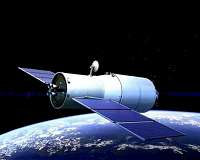
Commenting on China launching its first cargo spacecraft on April 20, experts told Sputnik that the Tianzhou-1 cargo resupply spacecraft's characteristics are much more sophisticated than those of US cargo spaceships.
In an interview with Sputnik, experts specifically focused on the characteristics of China's Tianzhou-1 cargo resupply spacecraft, which they said are much more sophisticated as compared to those of the US cargo spaceships Cygnus and Dragon.
Earlier on Thursday, the Tianzhou-1 cargo resupply spacecraft lifted off on a Long March-7 Y2 rocket from the Wenchang Satellite Launch Centre in the southern island province of Hainan.
The spaceship is set to dock with the Tiangong 2 space laboratory, also known as "Heavenly Palace 2."
"Tianzhou-1's 6.5 [metric] tons of payload [capacity], in comparison with the American spacecraft's [2.5 ton capacity], will allow China to more efficiently operate its space station," Alexander Zheleznyakov of the Russian Academy of Astronautics told Sputnik.
Touting Tianzhou-1's "relatively small weight for its class," Zheleznyakov recalled that China has yet to disclose Tianzhou-1's technical characteristics.
"But it is safe to assume that such a small weight of the spaceship could be explained by the fact that Tiznzhou-1 was made of new composite materials which are lighter than metal, for example. In this regard, the total weight-to-cargo ratio is much higher as compared to the US' Cygnus and Dragon spacecraft," he said.
Zheleznyakov praised the launch of Tianzhou-1 as a "big step" for Chinese astronautics, especially in terms of implementing the program to create a national orbiting space station and as an "outstanding event" for the international space sector.
"We witness the emergence of another major player, who will start to deal with cosmic research with the help of orbital space stations, like the ISS. China joining this club will contribute to the development of world cosmonautics in general," he said.
Zheleznyakov was echoed by Chinese expert Jin Yinshi, who touted Tianzhou-1's launch as a breakthrough in Chinese astronautics.
"The launch of Tianzhou-1 is of paramount importance. China's new generation Chang Zheng-7 Y2 booster was made domestically and operates using liquid oxygen. Its load capacity is brought to a very high level. It's already safe to talk about a new stage of cargo delivery, which will dock automatically with an orbital station and refuel during an autonomous flight," he said.
In early March, the newspaper China Daily reported that the Chinese Academy of Launch Vehicle Technology is breaking ground with techniques to send satellites into space via rockets shot from Chinese planes.
According to Li Tongyu, chief of rocket development at the academy, the technology will allow scientists and engineers to quickly replace "dysfunctional" satellites, as well as launch ad hoc, last-minute satellites into orbit, as part of disaster-relief efforts.
One advantage, according to experts, is that satellites can be launched from an aerial platform using solid-fuel rockets. Land-based rockets, which use liquid fuel, can take days or even weeks to transport the high volumes of fuel necessary for the launch, the paper added.
In just 12 hours, solid-fuel rockets can be ready for launch, according to Chinese Academy of Engineering estimates.
China launches first cargo spacecraft Tianzhou-1
A Chinese rocket successfully sent the country's first cargo spacecraft, Tianzhou-1, into space from the southern island province of Hainan Thursday.
Fuelled by liquid oxygen and kerosene, the Long March-7 Y2 carrier rocket blasted off from Hainan's Wenchang Space Launch Center at 7:41 pm (11:41 GMT).
Hundreds of spectators who had been waiting to observe the launch since the afternoon … read more
