
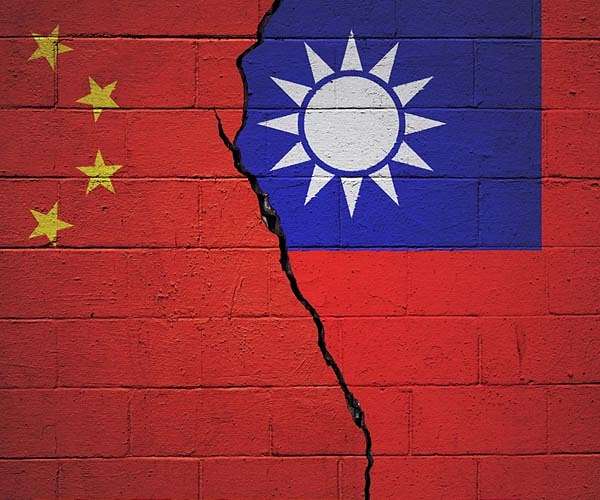
Chinese President Xi Jinping warned that relations between Beijing and Taipei were "grim" on Sunday, urging the island's main opposition party to help seek "unification of the country."
China views self-ruled democratic Taiwan as part of its territory and vows to retake it one day, by force if necessary.
Xi has become the most bellicose leader since Mao Zedong, describing the seizure of the island as "inevitable."
In a congratulatory letter to Eric Chu — the newly elected leader of the Beijing-friendly Kuomintang (KMT) party — Xi said the Chinese Communist Party and the KMT should collaborate under a "shared political basis."
"In the past our two parties insisted on '1992 consensus' and opposing 'Taiwan independence' … to promote peaceful developments in cross- strait relations," Xi said in the letter released by the KMT.
"At present the situation in the Taiwan Strait is complex and grim," he said, urging the parties to jointly seek peace and "the unification of the country."
Ties between Taiwan and China improved markedly under former president Ma Ying-jeou of the KMT between 2008 and 2016, culminating with a landmark meeting between Xi and him in Singapore in 2015.
The KMT has side-stepped frictions with China by accepting the so-called 1992 consensus — a tacit agreement that there is only "one China" without specifying whether Beijing or Taipei is its rightful representative.
In response, Chu said in a letter to Xi that the two sides should "seek common ground and respect their differences" to promote peace and stability in the Taiwan Strait.
Beijing has stepped up military, diplomatic and economic pressure on Taiwan since the 2016 election of President Tsai Ing-wen, who views the island as a sovereign nation and not part of "one China."
Last year, Chinese military jets made a record 380 incursions into Taiwan's defence zone, with some analysts warning that tensions between the two sides were at their highest since the mid-1990s.
On Thursday, China flew 24 warplanes including two nuclear-capable bombers into Taiwan's air defence zone, the biggest incursion in weeks, after voicing its opposition to Taipei joining a major trans-Pacific trade deal.
UK warship makes rare transit through Taiwan Strait
Taipei (AFP) Sept 27, 2021 –
The Royal Navy said a British warship was sailing through the Taiwan Strait on Monday, a rare voyage by a non-US military vessel through the sensitive waterway that is likely to strain ties with Beijing.
"After a busy period working with partners and allies in the East China Sea, we are now en route through the Taiwan Strait to visit Vietnam and the Vietnam People's Navy," tweeted HMS Richmond, a frigate deployed with Britain's aircraft carrier strike group.
Local media said it was the first time a British warship had transited through the narrow waterway separating Taiwan and mainland China.
The British navy survey ship HMS Enterprise transited through the strait in 2019.
US warships regularly conduct "freedom of navigation" exercises in the strait and trigger angry responses from Beijing, which claims Taiwan and surrounding waters — and almost all of the South China Sea.
The US and most other countries view those areas as international waters that should be open to all vessels.
Until recently, Washington tended to be the main power that defied Beijing by sailing through the Taiwan Strait.
But a growing number of US allies have transited the route as Beijing intensifies its military threats towards Taiwan and solidifies its control over the disputed South China Sea.
Canadian, French and Australian warships have all made voyages through the Taiwan Strait in recent years, sparking protests from China.
Taiwan's defence minister Chiu Kuo-cheng confirmed to reporters that a foreign vessel had sailed through the waterway but did not state which country it was from.
Britain's defence ministry did not respond to a request for comment.
Taiwan's 23 million people live under constant threat of invasion by authoritarian China, which has vowed to seize the island one day — by force if necessary.
Beijing has stepped up military, diplomatic and economic pressure on Taiwan since the election of President Tsai Ing-wen in 2016, who views the island as "already independent".
Last year, Chinese military jets made a record 380 incursions into Taiwan's defence zone, and the number of incursions for the first eight months of this year has already exceeded 400.
