
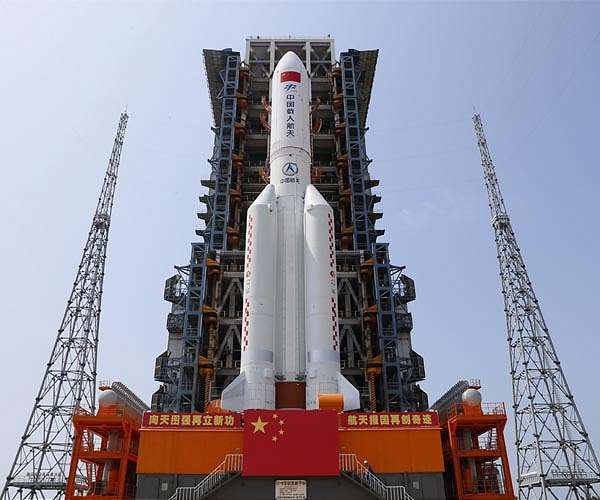
Chinese rocket debris weighing 23 tons is crashing to Earth in an uncontrolled descent Friday.
U.S. Space Command tweeted a confirmation that the rocket re-entered the Earth's atmosphere over the south-central Pacific Ocean at 4:01 a.m. Friday.
The rocket was launched on Oct. 31 carrying the third and final module for the Tiangong space station. Much of the debris is expected to burn up as it passes through Earth's atmosphere.
The Aerospace Corporation had calculated that the Chinese rocket would re-enter Earth's atmosphere Friday morning. Those predictive calculations include a huge area of possible re-entry, from parts of North America and nearly all of Central America to a large part of Africa and some of southeastern Australia.
A similar Chinese rocket re-entry happened in July with another Long March 5B rocket that also launched a Chinese space station module. That space junk came down over the Indian Ocean, with most of the debris burned and destroyed as the rocket fell through the Earth's atmosphere.
"The general rule of thumb is that 20-40% of the mass of a large object will reach the ground, but the exact number depends on the design of the object," the Aerospace Corporation wrote.
This is the fourth time that a Chinese rocket has fallen back to Earth uncontrolled. Space debris from other nations, including the United States, has also come back to Earth uncontrolled.
But Aerospace Corporation consultant Dr. Ted Muelhaupt said a small piece of SpaceX debris that landed uncontrolled in Australia was different that the Chinese uncontrolled descents.
"The thing I want to point out about this is that we, the world, don't deliberately launch things this big intending them to fall wherever," he said. "We haven't done that for 50 years."
But according to the Chinese Foreign Ministry, the way these rockets are re-entering Earth's atmosphere is not unusual. Foreign ministry spokesman Zhao Lijian said the Long March 5B rockets are designed for most of it to burn up and be destroyed during re-entry.
Spain briefly closes part of its airspace due to Chinese rocket debris
Madrid (AFP) Nov 4, 2022 –
Spain briefly closed part of its airspace on Friday as remnants of a Chinese rocket passed by, disrupting air travel in several cities including Barcelona, officials said.
Flights were "totally restricted" for 40 minutes in Catalonia in the northeast and several other regions "due to the risk associated with the passage of the space object CZ-5B through the Spanish airspace," Catalonia's civil protection service tweeted.
The airspace closure, which began at 9:38 am (0838 GMT), affected several other regions in northern Spain, it added.
Flights in and out of Barcelona, the capital of Catalonia, Tarragona, Reus and Ibiza in the Balearic Islands and other destinations were temporarily disrupted as a result, Spain's airport operator AENA said.
The rocket, the Long March 5B (CZ-5B), blasted off from southern China on Monday to deliver the last module for a Chinese space station currently under construction.
Debris from the rocket fell into the south-central Pacific Ocean at 11:01 am Spain time (1001 GMT), the US Space Command said in a tweet.
As rockets fall back to Earth, most of them burn up on re-entry, although large chunks may survive.
China has faced criticism for allowing rockets to fall to Earth uncontrolled in the past.
In July, remnants from a Chinese rocket fell into the Sulu Sea in the Philippines, prompting leading US officials to chide Beijing for not sharing information about the potentially hazardous object's descent.
