
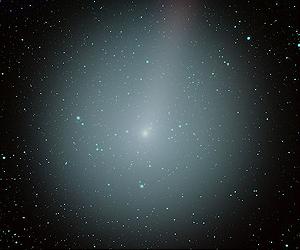
The small comet Hartley 2 makes its closest approach to Earth today and should be visible to the unaided eye for several days under dark skies in the hours before dawn, according to the editors of StarDate magazine. Early risers can take a look at the comet in anticipation of its November 4 encounter with NASA's Deep Impact spacecraft.
For help in finding the comet, download a sky chart from StarDate Media: http://stardate.org/mediacenter
While you're there, sign up to receive notices of future skywatching events from StarDate.
To view the comet this week, look northwest before dawn, about 75 degrees above the horizon – almost directly overhead. Hartley 2 will be near the bright star Capella, in the constellation Auriga, the charioteer.
The nearly full Moon will set about two hours before the Sun rises, allowing about 90 minutes of prime comet-viewing time. If you have difficulty viewing the comet, which is small and dim, try using binoculars.
Australian astronomer Malcolm Hartley discovered the comet in 1986. Less than a mile wide, it orbits the Sun every 6.5 years. On Wednesday, it will come within 11 million miles (18 million km) of Earth. The comet will make its closest approach to the Sun on October 28.
On November 4, Deep Impact will fly by the comet at a distance of about 430 miles (700 km), at a speed of 7.6 miles per second (12.3 km/sec). The probe will use a suite of instruments to study the comet's composition.
Share This Article With Planet Earth
