
The present study illustrates, for the hypersonic flows, through the local and marching analysis, the crossover of the mode W and the mode T at O(1) wavenumber and large Gortler number regime.
In fact, it is at this wavenumber regime that the instability is most likely to occur. The two approaches are expected to deliver similar results and the marching analysis helps to express the details of the crossover and confirm the result of the local analysis.
In fact the study of Gortler instability goes back to the date of the 1940s. Since Gortler's pioneering investigation on the boundary layer instabilities subjected to the negative curvature in 1940 highlighting the existence of the streamwise-oriented counter-rotating vortices, extensive studies have been carried out on this subject especially in the incompressible flows. These vortices are caused by the imbalance between the centrifugal force and the normal pressure gradient near a concave surface and exhibit a quasi-constant spanwise wavelength.
The most distinct difference between the incompressible counterparts is the existence of the trapped-layer mode (mode T) apart from the conventional wall layer mode (mode W) observed in the incompressible cases.
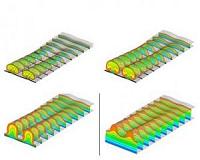
The velocity disturbances of the multiple Gortler modes are given below in Figure 1. It is evident that the mode T has its disturbances detached from the wall. As a result of this, the nonlinear development of Gortler vortices in hypersonic boundary layers shows considerable differences. Figure 2 shows the development of the streamwise velocity contours of the Gortler flow up to a fully saturated states.
The Mach numbers are 1.5, 3.0, 4.5 and 6.0 respectively. The famous mushroom structures (subsonic and moderate supersonic, e.g., Ma=1.5 and 3.0) are replaced by the bell shapes (hypersonic, e.g., Ma=4.5 and 6.0). This is because the mode T is the most dangerous modal shape in such flows.
To conclude, when considering the flow transition induced by the Gortler instability in hypersonic flows, the mode T highlighted in this article must be considered. Also, with appropriate parameters the mode T and mode W have crossovers. This study is a guidance for future studies of the secondary instability of Gortler vortices and flow transition in hypersonic boundary flows.
