
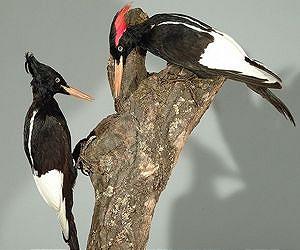
It was once the undisputed king of its clan, but most believe the imperial woodpecker faded unseen into the pages of history sometime in the late 20th century in the high mountains of Mexico.
But now, thanks to some keen detective work, the largest woodpecker that ever lived can be seen by the world once more – and this 85-second flight through time offers us a lesson about its behavior, and ours.
"It is stunning to look back through time with this film and see the magnificent imperial woodpecker moving through its old-growth forest environment, said research associate Martjan Lammertink, lead author of the paper along with four Cornell Lab of Ornithology staff members and two Mexican biologists. "And it is heartbreaking to know that both the bird and the forest are gone."
The imperial woodpecker was thought to have gone extinct without anyone ever capturing photos or film of the 2-foot-tall, flamboyantly crested bird.
That was until a biologist from the Cornell Lab of Ornithology tracked down a 16-mm film shot in 1956 by a dentist from Pennsylvania. The footage, which captures the last confirmed sighting of an imperial woodpecker in the wild, is available for viewing here.
In the color film, a female imperial woodpecker hitches up and forages on the trunks of large Durango pines and then launches into flight.
The film was shot by William Rhein with a hand-held camera from the back of a mule while camping in a remote location in the Sierra Madre Occidental in Durango state.
In March 2010, Lammertink and Tim Gallagher of the Cornell Lab launched an expedition with members of the conservation group Pronatura Noroeste to identify and survey the film site. The expedition turned up no evidence that imperial woodpeckers are still alive.
The entire range of the imperial woodpecker lay in the high country of the Sierra Madre Occidental – a rugged mountain range stretching some 900 miles south from the U.S.-Mexico border – and the Transvolcanic mountains of central Mexico.
The species largely vanished in the late 1940s and 1950s as logging destroyed their old-growth pine forest habitat. Imperial woodpeckers were also frequently shot for food, to use in folk remedies or out of curiosity.
The imperial woodpecker was the closest relative of the ivory-billed woodpecker, which suffered a similar decline from habitat loss in the southeastern United States and Cuba. A 2005 study by the Cornell Lab reported the rediscovery of an ivory-billed woodpecker in Arkansas, but subsequent region-wide surveys did not find evidence of a surviving population.
Why do woodpeckers resist head impact injury?
Head injury is a common concern around the world, but researchers suggest that woodpeckers may have an answer for minimizing such devastating injuries.
As reported in the Oct. 26 issue of the online journal PLoS ONE, an analysis of woodpecker anatomy and behavior revealed some features that could potentially be put to use in designing more effective helmets.
Woodpeckers are able to peck at a tree trunk at a high speed (6-7 meters per second), resulting in intense deceleration forces upon impact, without sustaining any brain injury.
To investigate the source of this protection, the researchers, led by Yubo Fan of Beihang University in Beijing and Ming Zhang of Hong Kong Polytechnic University, recorded the behavior using two synchronous high-speed video cameras, and also took scans of the birds' heads to reveal details about the micro-structural parameters such as the bone volume, thickness, and density etc.
They then constructed 3D models that allowed for further testing and measurement of the forces involved.
The results showed that specific details of the cranial bones and beak, such as the relative "spongy"-ness of the bone at different places in the skull and the unequal lengths of the upper and lower parts of the beak, were crucial for preventing impact injury.
The researchers conclude that the shock absorption system is not based on a single factor, but is a result of the combined effect of a number of different morphological features. This combination may be useful in guiding design for new protective gear.
