
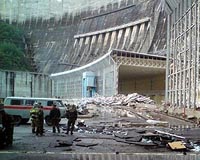
A day after a blast at a Russian hydroelectric plant, officials say there is little hope to find survivors from the 64 people missing.
So far, 12 people have been confirmed dead after the walls of a turbine room collapsed at the Sayano-Shushenskaya hydroelectric power plant in south central Siberia on Monday. Sixty-four workers remain missing, likely trapped inside the flooded facility.
"Finding anyone alive in the flood zone is unlikely, but the search continues," Vasily Zubakin, the chairman of state-run hydroelectric company RusHydro, which operates the plant, told Russian news agency Interfax.
Russian Emergencies Minister Sergei Shoigu said groups of divers were searching for survivors in the facility. "We are awaiting a robot, which is able to work underwater," he told Russian state TV.
The plant has stopped operating, with several energy-intensive smelting plants in the region affected. Two of the plant's 10 turbines are destroyed, and two more damaged, RusHydro said in a statement. The company added the damages would be in the billions of rubles.
Moscow has vowed to investigate the incident, which occurred when a pipe burst. Why it exploded remains unclear. Besides flooding the turbine room, the blast released tons of oil into the dam's reservoir, which has a surface area of 240 square miles. The spill, which is now moving northward down the Yenisei River, is to be cleaned up over the next weeks, officials have vowed.
In a bid to minimize the consequences of the accident, Russian President Dmitry Medvedev sent Energy Minister Sergei Shmatko as a crisis coordinator to the region. The Kremlin also promised the families of the dead that they would get financial aid.
Meanwhile, the region was in shock: Despite assurances from officials that it was intact, downstream residents fled the region afraid that the dam could collapse.
"People started refilling the gas in their cars, buying bread, salt and matches and moving uphill," Olga Kolesnikova, spokeswoman for the Khakasia regional government, told the Moscow Times.
The hydropower station, Russia's largest power plant, is located at the Yenisei River in the south central Siberian region of Khakasia, nearly 1,900 miles east of Moscow. More than 800 feet high and 3,500 feet long, the dam has a capacity of 6,400 MM. It produces on 23.5 TWh per year, making it the world's fifth-largest hydroelectric station.
Its biggest customers are two smelters owned by United Company Rusal, the world's largest producer of aluminum.
The hydropower plant will restart its operations within the next six weeks, but replacing the damaged turbines could take up to four years, the Moscow Times reports.
Share This Article With Planet Earth
