
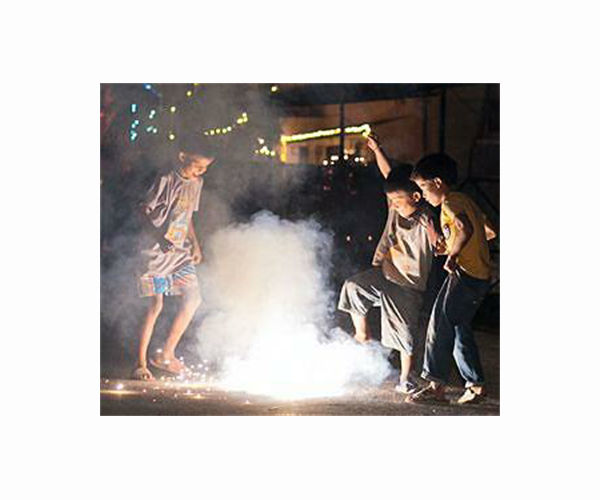
New Delhi woke up to a thick blanket of toxic smog on Friday after an overnight barrage of firecrackers for the Hindu festival of Diwali in the Indian megacity, despite a ban on selling them.
At various hotspots, levels of harmful PM 2.5 particles topped 400 on average on the air quality index.
The figure is more than 15 times higher than the safe daily limit set by the World Health Organization.
India's top court has banned the sale of firecrackers in Delhi and the local government urged people to celebrate Diwali without them.
But many of the capital's roughly 20 million residents still got hold of them, setting them off all over the city until the early hours of the morning for the annual Festival of Lights.
Firecracker smoke combines with industrial and vehicle emissions and farm fires to create a putrid grey-yellow soup that envelops Delhi and other Indian cities in winter.
Sandeep, a Delhi resident, told AFP on Friday he did not think the government was doing enough to counter the pollution challenge.
"I think a great deal (more) needs to be done," he said while on a morning walk at Delhi's Lodhi Gardens.
"Not only are we coughing more, we are getting irritation in the throat and catching cold more easily."
A 2020 report by Swiss organisation IQAir found 22 of the world's 30 most polluted cities were in India, with Delhi ranked the most polluted capital globally.
The same year, the Lancet said 1.67 million deaths were attributable to air pollution in India in 2019, including almost 17,500 in the capital.
Toxic smog chokes Indian capital during Diwali celebrations
New Delhi (AFP) Nov 4, 2021 –
India's capital was choked in a shroud of thick, toxic smog on Thursday as millions gathered with family and friends to celebrate the Hindu festival of Diwali.
New Delhi is ranked as one of the most polluted cities globally, with a hazardous melange of factory emissions, car exhaust and smoke from agricultural fires settling in the skies over its 20 million people each winter.
People across the sprawling city woke to find themselves enveloped in a grey-yellow blanket of haze, with experts warning of worse to come in the days ahead.
Levels of PM2.5 — the smallest and most harmful particles polluting the air — peaked at an average of 389 on Thursday, according to readings from metropolitan monitoring stations run by government air quality agency SAFAR.
The figure is more than 15 times higher than the safe limits set by the World Health Organization.
SAFAR advised residents to avoid outdoor activities and wear masks when outside.
The agency also warned that illegal fireworks traditionally used to mark the Diwali festival could further heighten pollution levels on Friday.
Delhi and many neighbouring cities have banned or highly restricted their use to avoid a spike in air pollution.
In the lead-up to the festival, police seized four tons of firecrackers from around the city and arrested dozens selling them illegally.
The capital witnesses its annual smog crisis at the onset of winter, when temperatures drop and air moisture levels rise.
Low wind pressure over the city often traps pollutants emanating from vehicles and industries.
The problem is compounded by agricultural fires, set by farmers in neighbouring states to clear their lands of crop residue before the next planting season.
The practice was banned in 2015 but continues unabated, and smog levels are set to spike further in the coming days as the burning reaches its annual peak.
"The share of pollution from stubble burning has increased from eight percent to 25 percent today and on Friday it will be 40 percent," Gufran Beig, SAFAR's programme director, told AFP.
A 2020 report by Swiss organisation IQAir found 22 of the world's 30 most polluted cities were in India, with Delhi ranked the most polluted capital globally.
The same year, the Lancet said 1.67 million deaths were attributable to air pollution in India in 2019, including almost 17,500 in the capital.
