
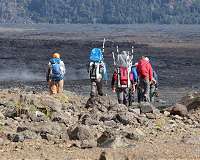
On the lava fields of Hawaii's Kilauea volcano, a team of NASA researchers and partners have been busy doing science in a most unusual way. They were studying the biology and geology of this remarkable terrain while simulating a realistic mission to the surface of Mars.
The conditions were so real that many of the expected challenges of otherworldly exploration were recreated, including a communications delay of several minutes, and limited bandwidth for transmitting data.
"Our project is a unique integration of science, operations and technology research in service of future human spaceflight," said Darlene Lim, a scientist at NASA's Ames Research Center in California's Silicon Valley, and principal investigator of the Biologic Analog Science Associated with Lava Terrains project, called BASALT.
"Our goal is to design the exploration of the future, and when you add science to the mix, that changes everything!"
In addition to lending its name to the research program, basalt is a type of rock that forms when lava solidifies, and this is what interests the group's science team. Hawaii's volcanic activity today is a good stand-in for the conditions that existed on ancient Mars.
Biologists, geologists and geochemists work together on this project to understand the lifeforms, such as bacteria, that grow on these rocks, and the factors that allow them to thrive. What the researchers discover about life in relation to Hawaii's basalt environments may help scientists choose the best sites to target when searching for signs of life – current or past – on Mars.
When the time comes, scientists will not be alone in that endeavor, nor are they alone on the BASALT mission. The BASALT scientists work side by side with a broader team of 40 people, drawn from areas such as engineering, software development, communication systems, human factors, and exploration technologies.
This year's field tests, which took place November 1-21, 2017, built on BASALT's two previous deployments. Team members carefully evaluated scientific methods, exploration procedures, and new versions of software tools for planning explorers' timelines, based on the group's research results so far.
New in 2017 were two tools to help both Earth- and Mars-based crews see what's happening on the ground. High-resolution, 360-degree photos, such as might be taken by a companion Mars rover during a future human mission, captured the landscape that the simulation's astronauts would explore.
This gave the science team a chance to choose, in advance, locations likely to be of interest to their research. BASALT collaborators at NASA's Jet Propulsion Lab, in Pasadena, California, and the Massachusetts Institute of Technology, in Cambridge, were also there, testing innovative tools that will let multiple users see and explore the Martian landscape together.
Together, this team is working to identify, design, test and build upon the tools that human explorers will need when they first set foot on Mars and begin studying a new world.
Powering up NASA's human reach for the Red Planet
NASA is pushing forward on testing a key energy source that could literally "empower" human crews on the Mars surface, energizing habitats and running on-the-spot processing equipment to transform Red Planet resources into oxygen, water and fuel.
The agency's Space Technology Mission Directorate (STMD) has provided multi-year funding to the Kilopower project. Testing is due to start in Nov … read more
