
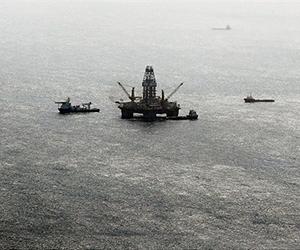
Tasked by DNV with developing new ideas for oil recovery at 2,500 metres depth in the Gulf of Mexico, a group of 20 international graduating master's students have proposed a subsea concept involving a submerged tension leg processing platform midwater to evade the difficult conditions on the seabed.
Additionally, storage tanks at 200 metres depth avoid the use of an FPSO and the complications of bad weather risks while still being accessible for shuttle tankers and intervention.
Taking a nuanced approach to what can be done where, the students propose combining existing technology in new ways and new places. By finding an optimal depth for the different processes, it will also be easier to standardise the equipment. This concept, called SPSO (Subsea Processing, Storage and Offloading) Cobia, would be able to operate 300 km from shore.
The proposed processing facility at a depth of 1,000 metres will have a robotic arm that can reach all platform elements for intervention and component replacement tasks, supplemented by a connected ROV to carry out intervention on the platform, seabed and crude storage tanks.
The entire SPSO Cobia would be powered electrically directly from shore using a long distance low frequency power cable coupled with high voltage motors.
Technically and economically feasible
Based on initial assessments, the students argue that the concept is technically feasible and may become profitable at oil prices as low as USD 66 per barrel and have an internal return rate of nearly 14%. CAPEX is calculated to be NOK 22 billion (USD 4 billion) and OPEX NOK 750 million annually.
Well received by the industry
Representatives of DNV and the industry who saw the students' presentation and documentation have expressed interest in the ideas and solution, citing the students' familiarity with other projects and existing technology as additional strengths.
DNV's CEO Henrik O. Madsen says the ideas and reasoning behind them were impressive and worth further research, as the concept struck him as feasible, adding that "fresh knowledge from students is giving DNV different perspectives and the summer project is a unique way to add new impulses to our organisation."
About DNV's annual summer project:
+ A group of graduating master's students from all over the world is chosen in an application process.
+ The students solve relevant and challenging R and D tasks during seven summer weeks, with coaching from DNV experts.
+ The solution is presented to the company and industry players at the end of the project.
+ Twenty students were accepted for the project in 2013.
+ Half of the students involved in 2012 were offered a job at the end of the project.
